
Article made possible by my amazing patrons, with particular thanks to: Mick McAteer, Bert Rothkugel, Chris Gravell, Duncan Black, Jane Turner, Joey, John Hendy, Konrad, Neil Barton, Nicholas Martin, Patrick Lefevre, Ruth Holliday, Scott Folan, Thomas Alexander, Unicorn
Following the 2019 general election, the Green Party faced an existential crisis. The party won a mere 3% of votes, and did not gain a single extra seat, leaving them stuck at 1 seat for the 9th year in a row. Things had to change, and members knew it. In the 2020 contest, the incumbent co-leaders saw their vote plunge from almost 80% in 2018 to just 49%; within a year, both had stepped down. Carla Denyer and Adrian Ramsay went on to lead the party to win 7% of the vote and 4 seats in 2024. Their fortunes were looking up.
But things started going wrong. Members watched in horror as the mistakes of 2019 were repeated yet again by a leadership that shied away from controversy, or indeed any media coverage at all. Labour’s support dropped off a cliff, but the Greens did not gain. In 2025, the party’s projected vote share in the local elections was lower than it was in May 2024. Something had to change. It did.
In September 2025, Zack Polanski was elected leader. He laid out a clear strategy for growth: attack Labour, rile up the media, use non-traditional media to expand the party’s base, and talk about the issues that matter most to voters instead of dropwort. His opponents said he would destroy the party.
Eight months into Zack’s leadership, the case he made to members has been proven correct beyond any shadow of a doubt. 220,000 members, a poll average of 16.5% and a stonking by-election win in a safe Labour constituency has banished all doubts. And the surge shows no sign of slowing down.
In this article I will outline the current state of the polls, with a focus on where the Green Party’s surge in support has come from. They might not be polling first, but the age of Polanski has already reshaped British electoral politics, and after the May elections the party is likely to surge again.
Voting intention
In March 2026, the average of polls was as follows (+/- vs the general election):
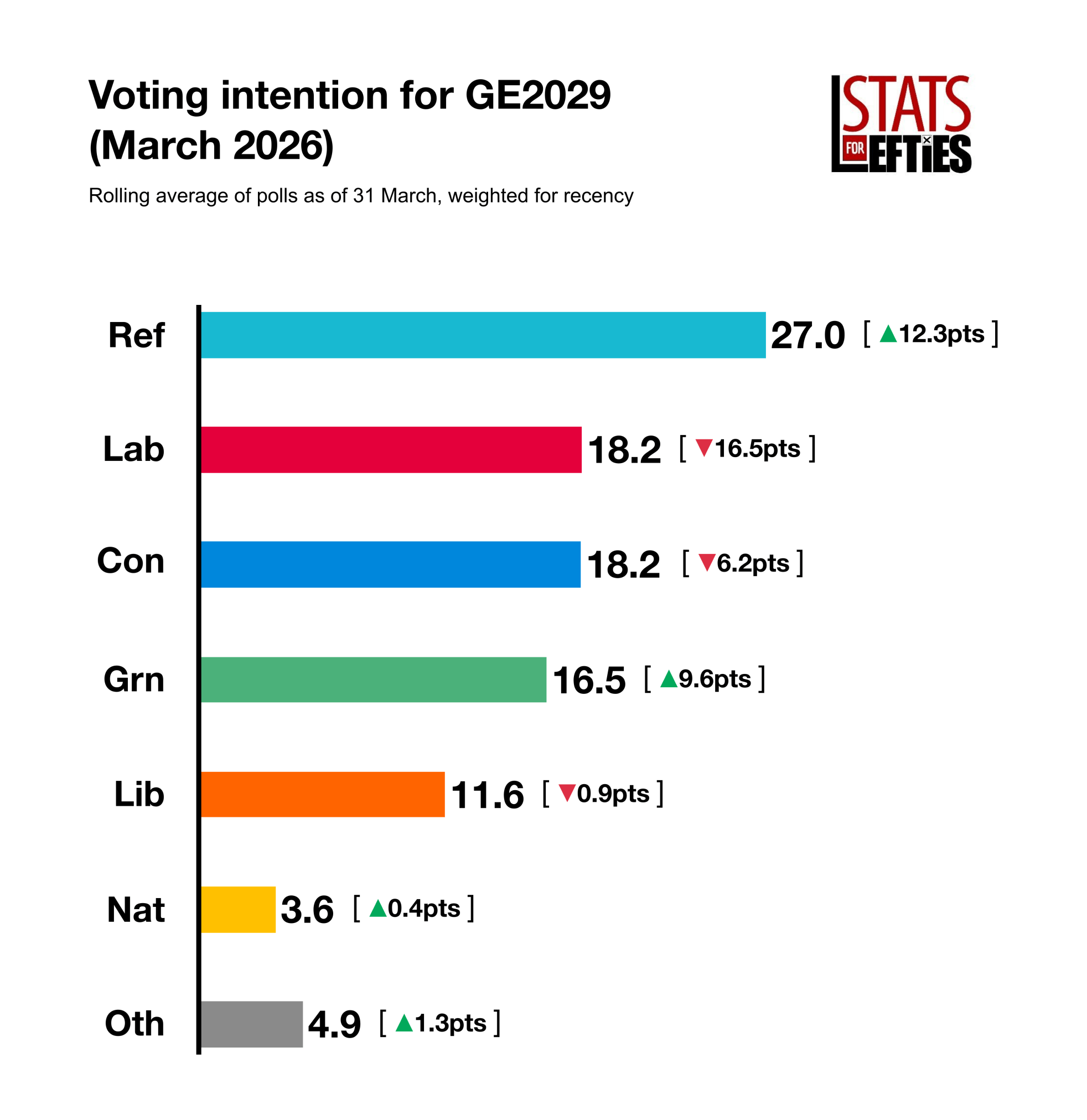
After almost two years of Labour, all three major parties are doing poorly. Just 18.2% of Brits would back Labour in an election tomorrow, the lowest that the party has ever polled. The Tories, once a major party, are tied with Labour on just 18.2%. The Liberals, meanwhile, are polling at 11.6%, lower than in 2024, with their seat count flatlining.
Instead of the major parties battling it out, the polls suggest that two minor parties have seized control of the political debate despite winning fewer than 10 seats combined in 2024. Nigel Farage’s Reform party remains out in front for the 12th month in a row, enjoying a solid 8.8pt lead over Labour. Despite this lead, the party’s vote share has weakened quite a bit; having peaked at over 31% in September 2025, Reform is now averaging 27%. This is not quite the dramatic collapse that some liberal commentators have been boasting about, but it is an undeniable drop outside margin of error. Their meteoric rise has undeniably stopped.
The Greens, meanwhile, have surged to an all-time high. Under Polanski’s leadership the party is now averaging around 16.5%, less than two points behind both Labour (18.2%) and the Conservatives (18.2%). Prior to Polanski’s election, his party was flatlining at 8.6%. Far from alienating millions of voters, Polanski has in fact attracted 2.7 million new voters.
Seat estimate
My seat projection model (available here) suggests the following seat outcome:
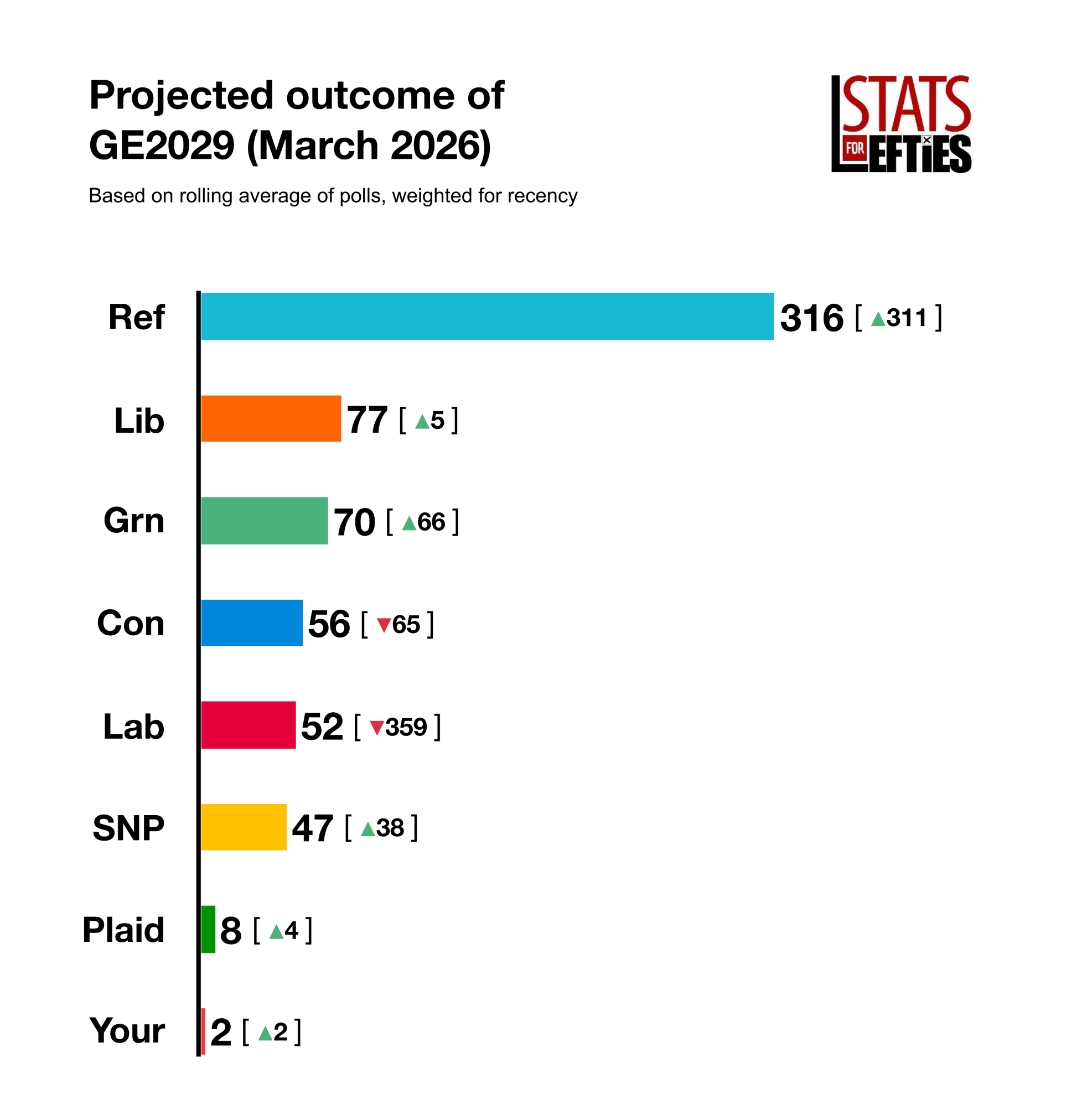
These figures are without precedent. Labour would win just 52 seats, experiencing the most shattering defeat of any government in British history, losing 359 of their 411 seats (87%). Of the 25 Labour MPs who sit in the Cabinet, a stunning 21 of them (84%) would lose their seats, with the four survivors teetering on the edge of losing. One of the Cabinet survivors would be Keir Starmer, who would cling on with a mere 28% of votes due to the opposition vote being split between the Greens (25%) and independent socialist Andrew Feinstein (12%).
Yet Labour’s traditional opponents, the Conservatives, would not benefit; they would lose 65 of their 121 seats and would end up with just 56 seats, their lowest seat total in the history of the party. The Lib Dems, benefitting from efficient seat targeting and a vote share concentrated in the South, would end up with 77 seats (up 5) – surpassing the Labour Party’s seat total for the first time in over 100 years.
But even this historic accomplishment would be overshadowed by the results for the three biggest winners. Under Farage’s leadership, Reform would seize 316 of 650 seats in the Commons, allowing him to wield a working majority with the support of right-wing unionist MPs from the six counties (bringing him to 322 seats, a working majority of 2).
At the same time, the Green Party of England and Wales would win a whopping 70 seats (+66), putting them in third place – ahead of Labour and the Conservatives. Greens would win a majority of parliamentary seats in Sheffield, Manchester, Newcastle and Bristol, as well as 2 of the 5 seats in Liverpool. Their best result would be in Greater London, where they would win 19 of the 75 available seats (25%) including Tottenham and both Hackney seats.
And on top of all that, the nationalists would have an amazing night. The SNP would bounce back from their humbling 2024 loss and win 47 out of 57 seats in Scotland (82%), completely wiping out Labour’s 2024 gains and regaining all but one of the 48 seats they won in 2019. Their Welsh cousins Plaid Cymru would win the popular vote and snag an all-time high of 8 seats (+4), but the extremely inefficient distribution of their vote makes further gains unlikely.
From this month I have started producing estimates for Jeremy Corbyn’s Your Party (YP). They are currently projected to win just 2 seats (down from 4 currently):
- Jeremy Corbyn in Islington North (HOLD)
- Ayoub Khan in Birmingham Perry Barr (HOLD)
In addition to this, two unaffiliated independents would be elected:
- Iqbal Mohammed in Dewsbury and Batley (HOLD)
- Leanne Mohammed in Ilford North (GAIN from Labour)
In Birmingham Yardley, the Workers Party would gain the seat from Jess Phillips.
Polanski’s determination to target poorer, urban left-leaning voters has begun to pay off for his party. The Greens are now projected to win big in six major cities:
- 4 of 4 seats in Manchester (100%)
- 3 of 5 seats in Sheffield (60%)
- 2 of 3 seats in Newcastle (67%)
- 2 of 5 seats in Liverpool (40%)
- 3 of 10 seats in Birmingham (30%)
- 19 of 75 seats in London (25%)
Whilst dramatic, we can absolutely believe that these results are possible because the Greens won the Gorton and Denton by-election in a landslide victory – and that was the seat in Manchester least likely to go Green.
How has this happened?
Labour strategists remain convinced that they have collapsed because they’re losing millions of voters to Reform. Using this as an excuse, they have embraced the politics they have always dreamed of – right-wing populism, racism, ableism, genocide and imperialist wars of conquest.
But this analysis of the electorate is based on nothing but vibes. Labour’s collapse is not the result of a right-wing surge, but of left-wing dissent! Just 48% of those who voted Labour in 2024 would do so tomorrow, with the other 52% defecting to other parties. And of those, a whopping 71 percent are moving left, not right.
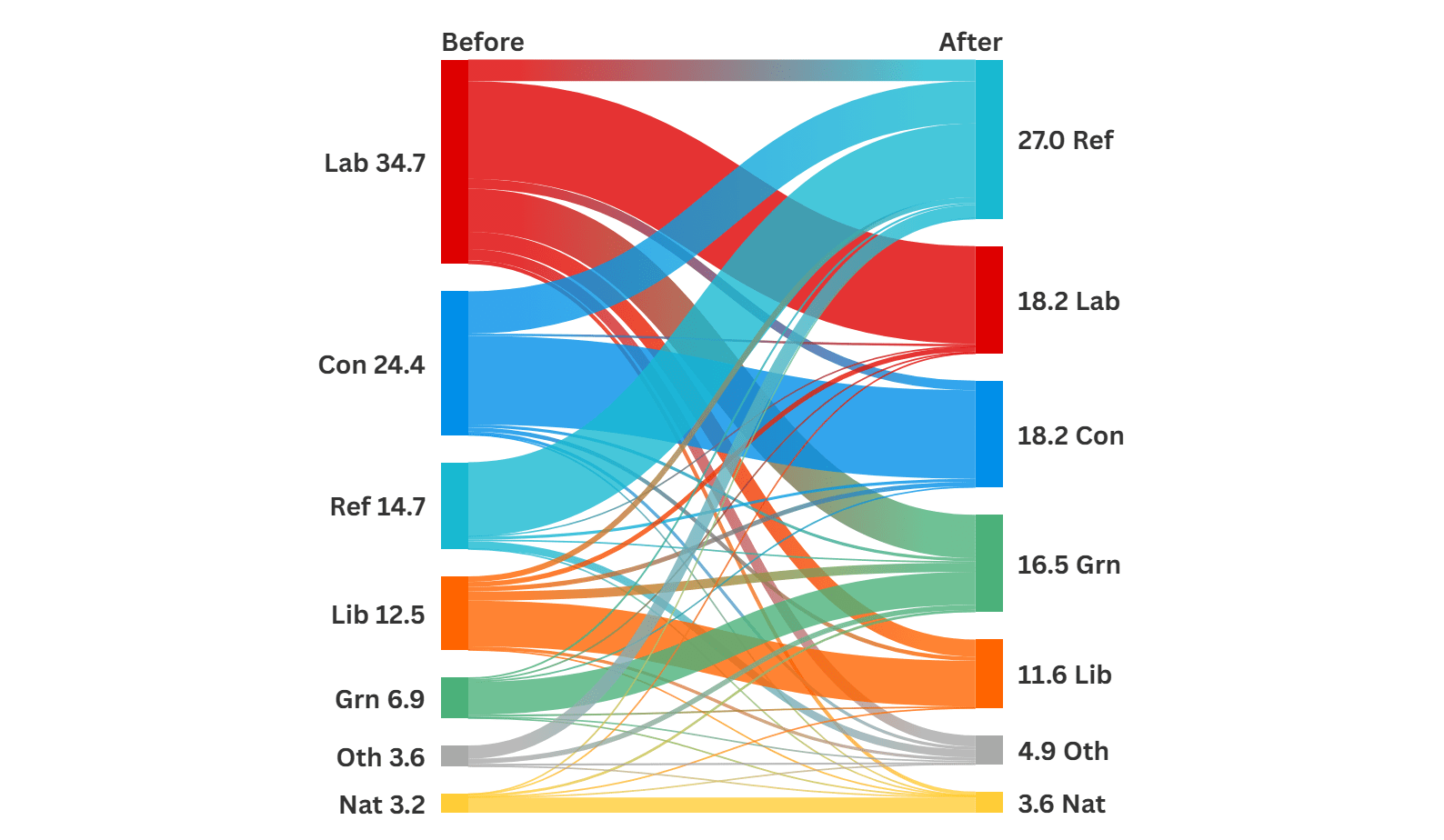
If Labour won back all the voters it has lost to Reform (3.6pts) they would still be trailing Farage in the polls. If they won back all those who have gone Green (7.4pts), they’d be ahead. It really is that simple.
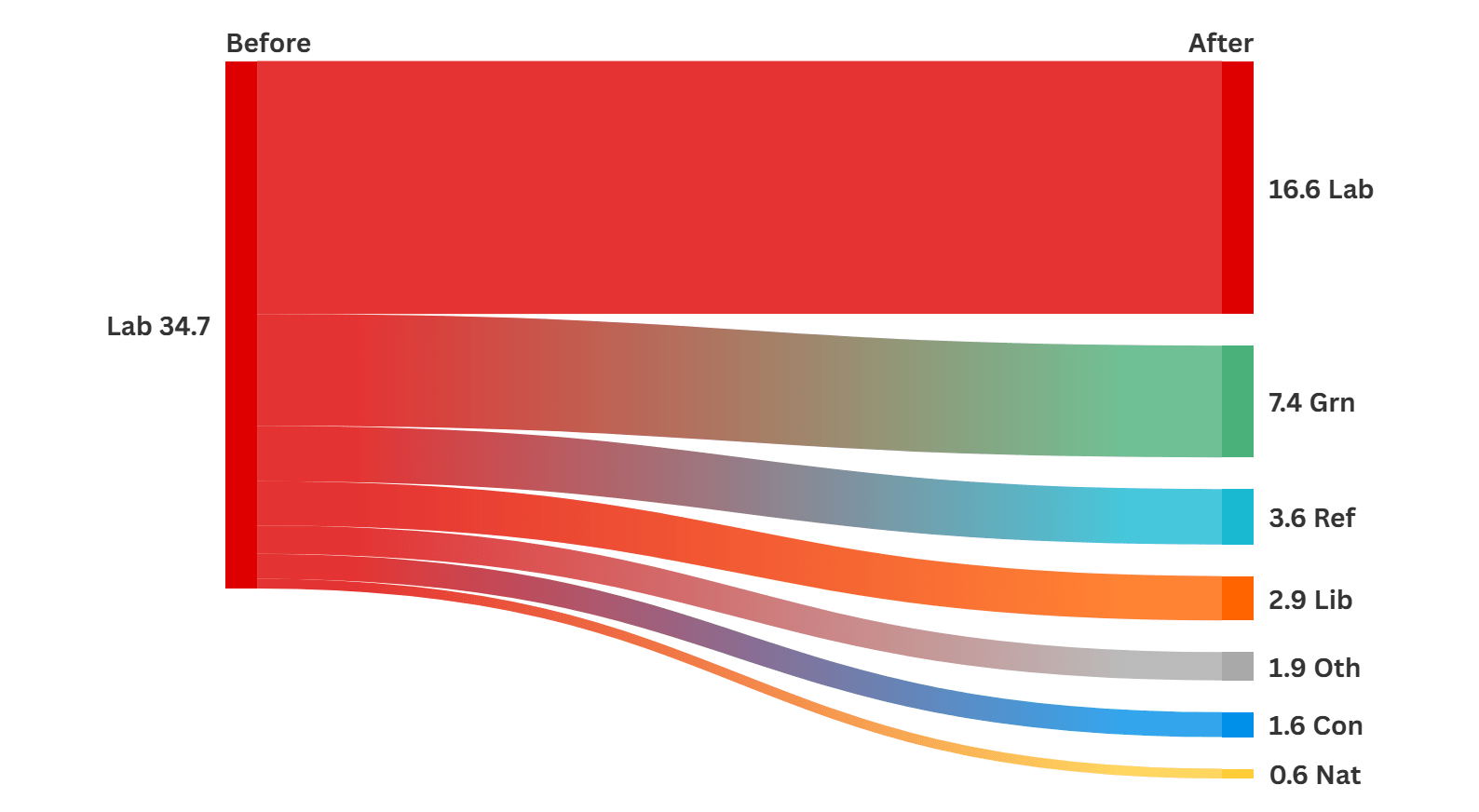
As for Reform – if not from Labour, where are their votes coming from? Half of their new voters (50%) backed the Conservatives in 2024, while just 25% supported Labour. This calculus is partly why Farage, who at one point was adopting left-leaning rhetoric (like abolishing the benefit cap), has swung back to the right. After shellacking defeats in Caerphilly and Manchester, he is very aware that the few Labour voters he was winning over are more anti-Starmer than anything else; when offered only Reform, they will vote against Labour (see: Runcorn and Helsby), but when a left option is available they embrace it.
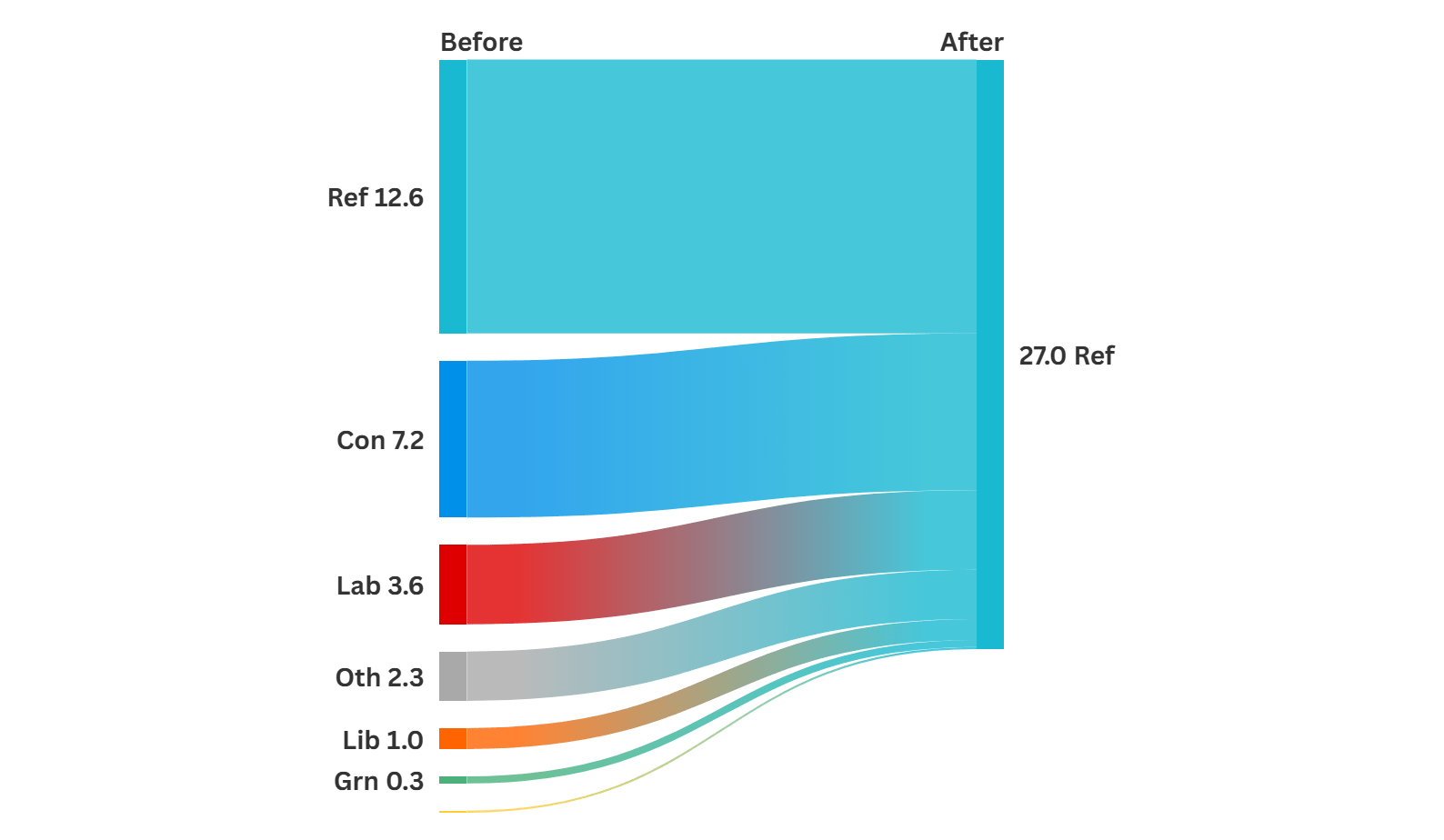
Whilst this may seem promising, it should be noted than in many places in the North of England, Reform remains the only viable opposition to Labour – so we can expect to see big Reform gains in the North East even as they are likely to struggle in London and Birmingham (where left-wing alternatives are viable).
Leadership approval ratings
Keir Starmer’s net approval hit an all-time low of -49 in February, and it was hard to go lower than that. As would be expected in a time of war, the PM’s approval rating has risen slightly (just as it did in March 2025, when Starmer attempted to drag us into a war with Russia) to a still miserly -45.
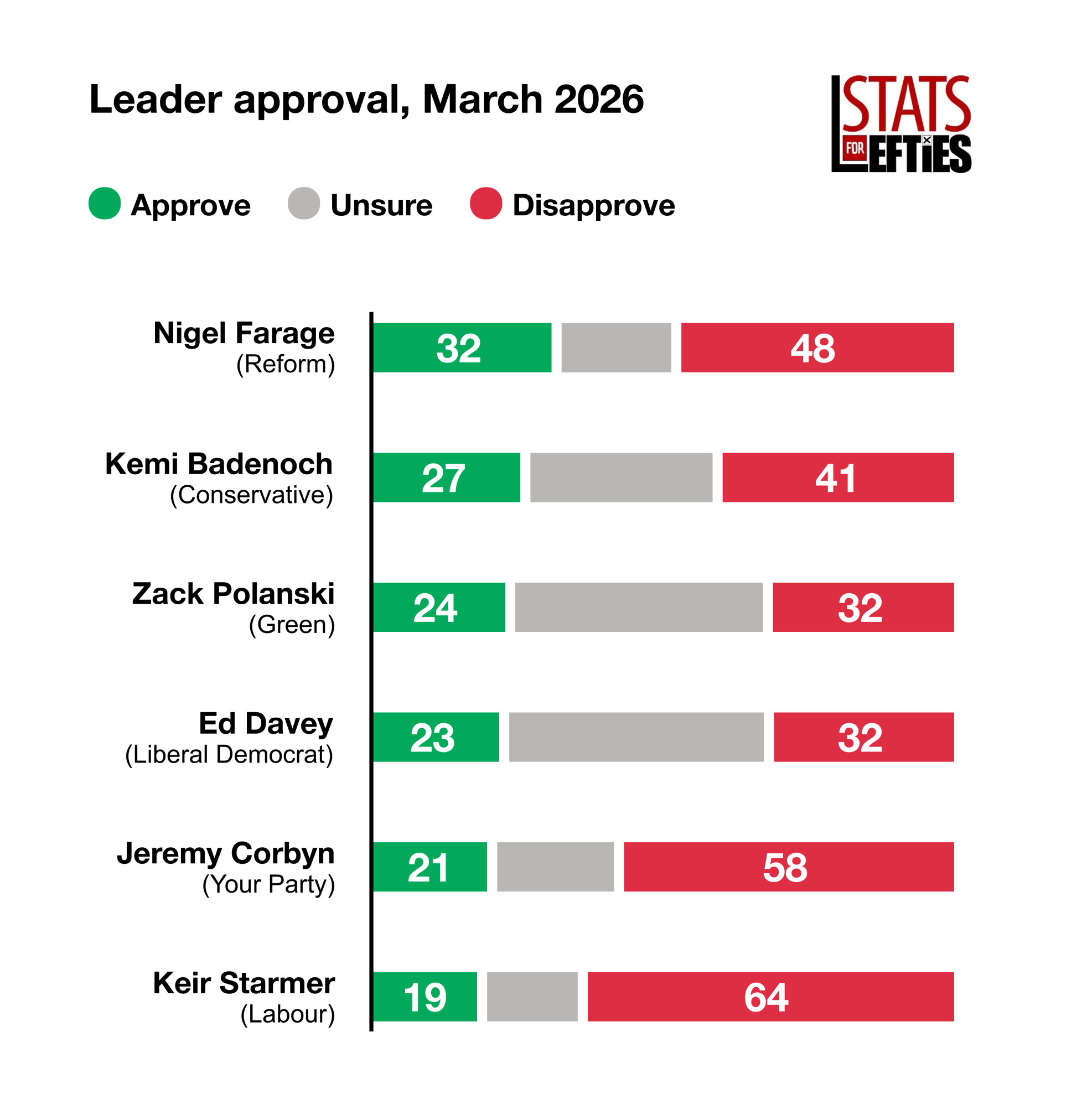
Nigel Farage remains the most popular party leader in terms of raw approval (32%), followed by Kemi Badenoch (27%), Zack Polanski (24%) and Ed Davey (23%). Just 19% approve of the Prime Minister’s performance, fewer than approve of Your Party’s Jeremy Corbyn (21%).
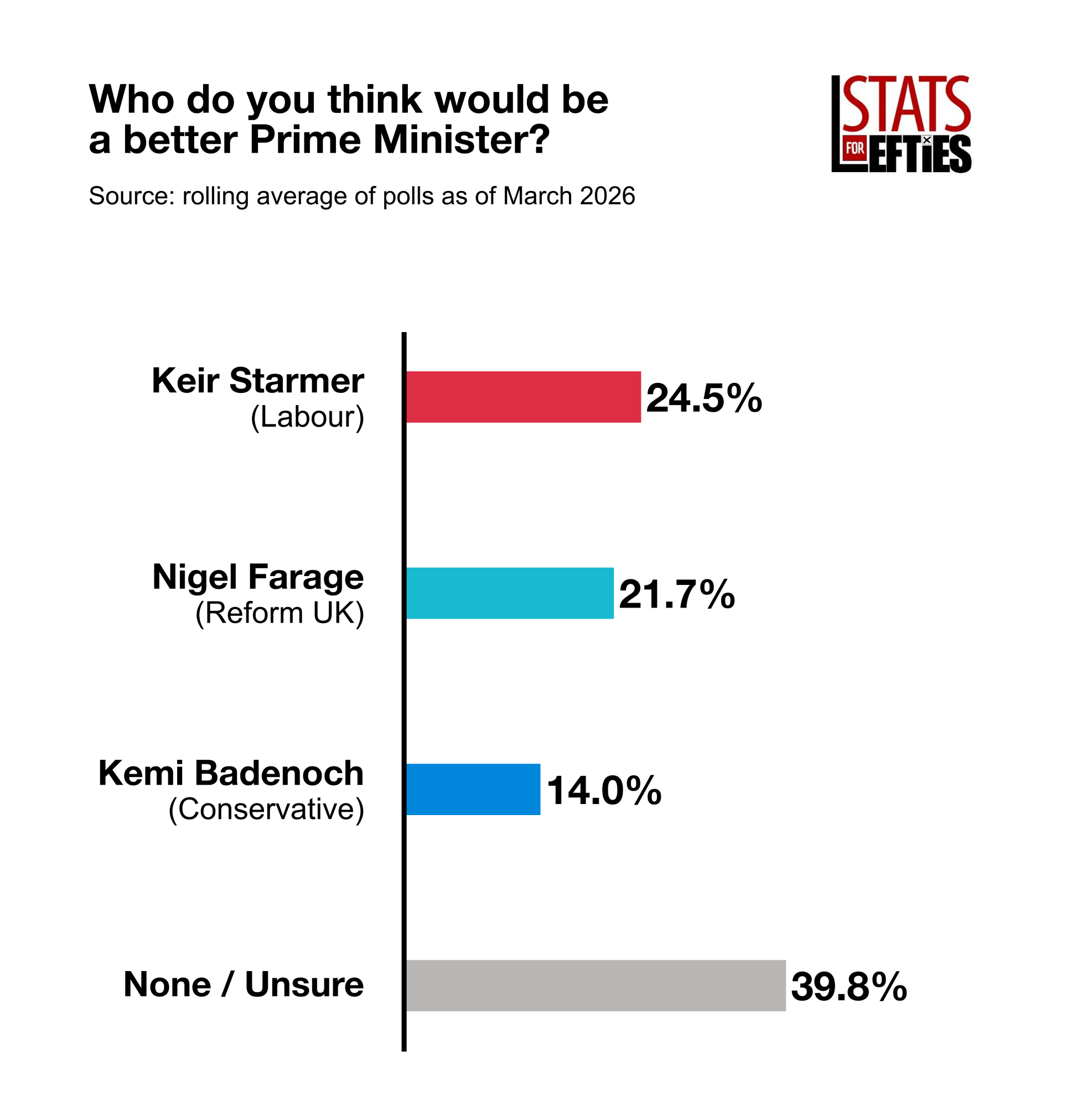
In terms of who people think would make the better Prime Minister, Starmer continues to hold a slight lead of 2.8pts over Farage in multi-candidate polls.
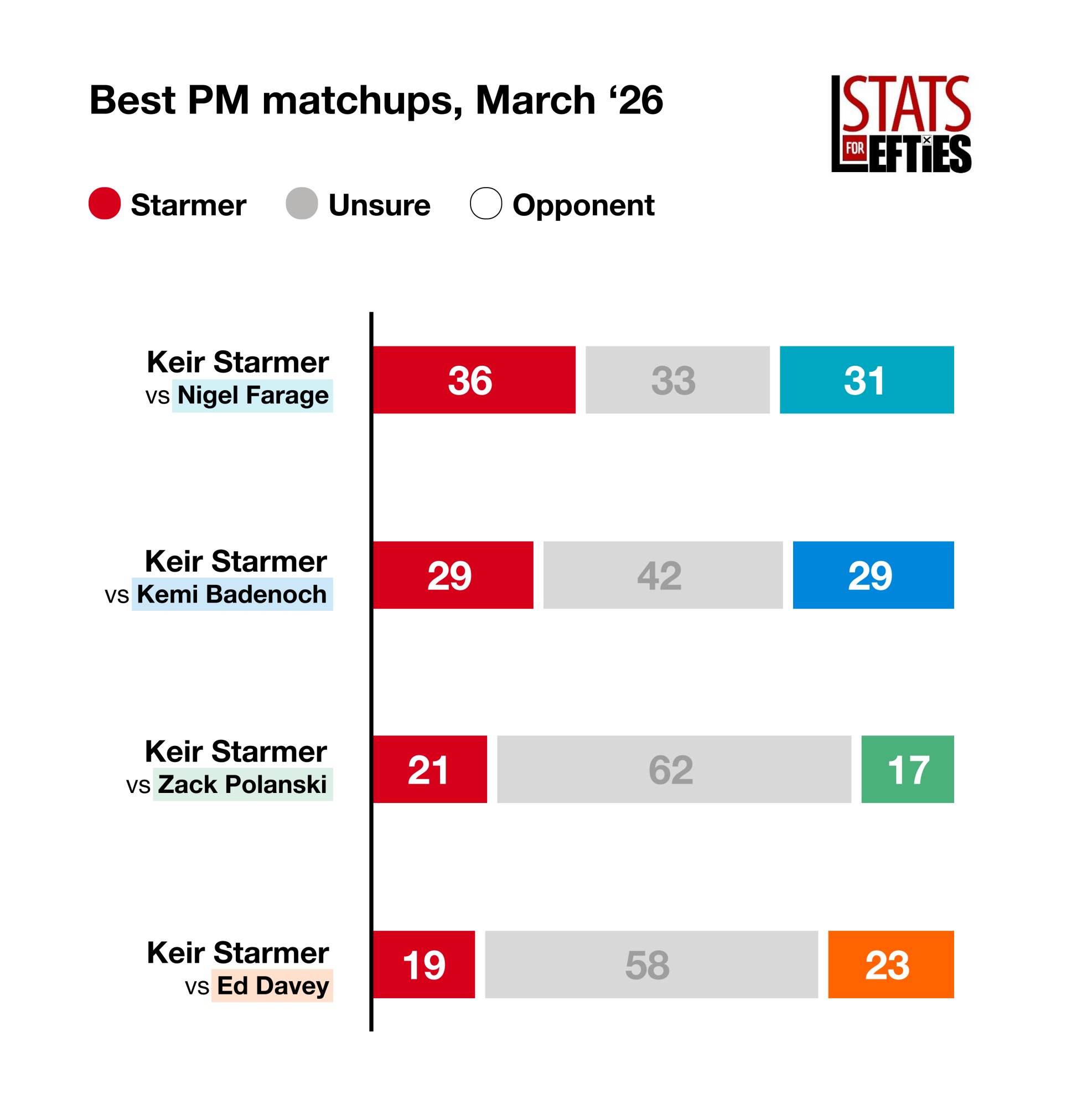
In head-to-head matchups, Starmer leads Farage by 5pts, but is tied with Kemi Badenoch at 29% each and trails Ed Davey by 4pts. Nonetheless, he leads Zack Polanski by 4pts.
Conclusion
With less than a month until legislative elections in Scotland and Wales, and major local elections in England, Labour’s position is abysmal. The government has gone all in on Starmer’s personal leadership, desperately hoping that joining a war of imperial conquest, joining hands with Trump and looting Iran for its wealth will catapult him back to popularity. So far, there is no evidence that this is working. His approval remains shockingly low, and is the worst of any party leader.
His sole strength remains his major opponent, Nigel Farage, who continues to be a useful foil for Labour. Despite just 19% approving of the PM, a whopping 36% would prefer him to Farage in a forced choice. These sorts of results have convinced Labour’s strategists that a pitch of “it’s us or Reform, you choose” will get them over the line in May and in 2029.
The problem with this plan is that its proponents are living in a reality that no longer exists, and are pumping out propaganda that voters genuinely feel insulted by. In Scotland’s Holyrood elections, the SNP are the frontrunners, with Reform plausibly set to come third. The idea that Labour are the only ones who can beat Reform in Scotland is a blatant lie, and voters are fully aware of it. In Wales, Plaid Cymru have always been a strong alternative to Labour, but since the Caerphilly by-election they have rocketed to first place in polls, and are now set to be the largest party. The idea that only Labour can keep Reform out in Wales is another blatant lie, and Labour’s insistence on roaring lies at the electorate is not going down well. It’s hard to bully people into backing you out of fear when those same people have seen undeniable evidence that you are completely incapable of beating Reform.
England was the last place that Labour’s propaganda line had any shot of succeeding, and the Gorton and Denton by-election decisively put an end to it. Labour spent weeks screaming at the voters that only Labour could beat Reform, that the Greens would get utterly crushed and obliterated, and that only Labour could keep out Farage and his boys. On the day, the Green Party won by double-digits and Labour’s vote was cut in half. Awareness of this by-election amongst the broader electorate was extremely high, partially due to the drama around Andy Burnham being blocked from running. As a result, Labour’s tactical squeeze message has been completely undermined. At this point, it is impossible to avoid the conclusion that “it’s us or Reform, choose” will never work again. Labour has deployed it in three high-profile anti-Reform contests (Runcorn & Helsby, Caerphilly and Gorton & Denton) and its message has fallen utterly flat and resulted in humiliation all three times.
This “tactical voting” squeeze message was Labour’s last chance to avoid total catastrophe in May’s elections. Gorton and Denton proved overwhelmingly that voters are no longer listening, and the polls have shifted to reflect that. The elections in May will be a shellacking for Labour, and the big expected winners (Reform and Greens) will see a boost to their polling in the aftermath as wavering voters jump on the bandwagon. I’m going to confidently say that within the next two months, the Greens will overtake Labour in the polls on average. They’re almost there already; a bandwagon bounce will make it official.
All of this was entirely avoidable. Labour could have pulled back on its extreme right-wing measures (such as slashing disability benefits and imprisoning protesters) and prevented these losses to its left flank. But because Labour is led by dinosaurs stuck in 1997, they still completely believe that the left has “nowhere else to go”. As Gorton and Denton proved, this belief is not based on anything real. In truth, in 2026, the left has many options – the SNP in Scotland, Plaid Cymru in Wales, Greens across the UK, and local independent groups in metropolitan councils across England. In a month, they will pick those options, and at this point it is far too late for Labour to stem the tide.
May’s elections will be a rout for Labour, and I for one can’t wait to watch.

