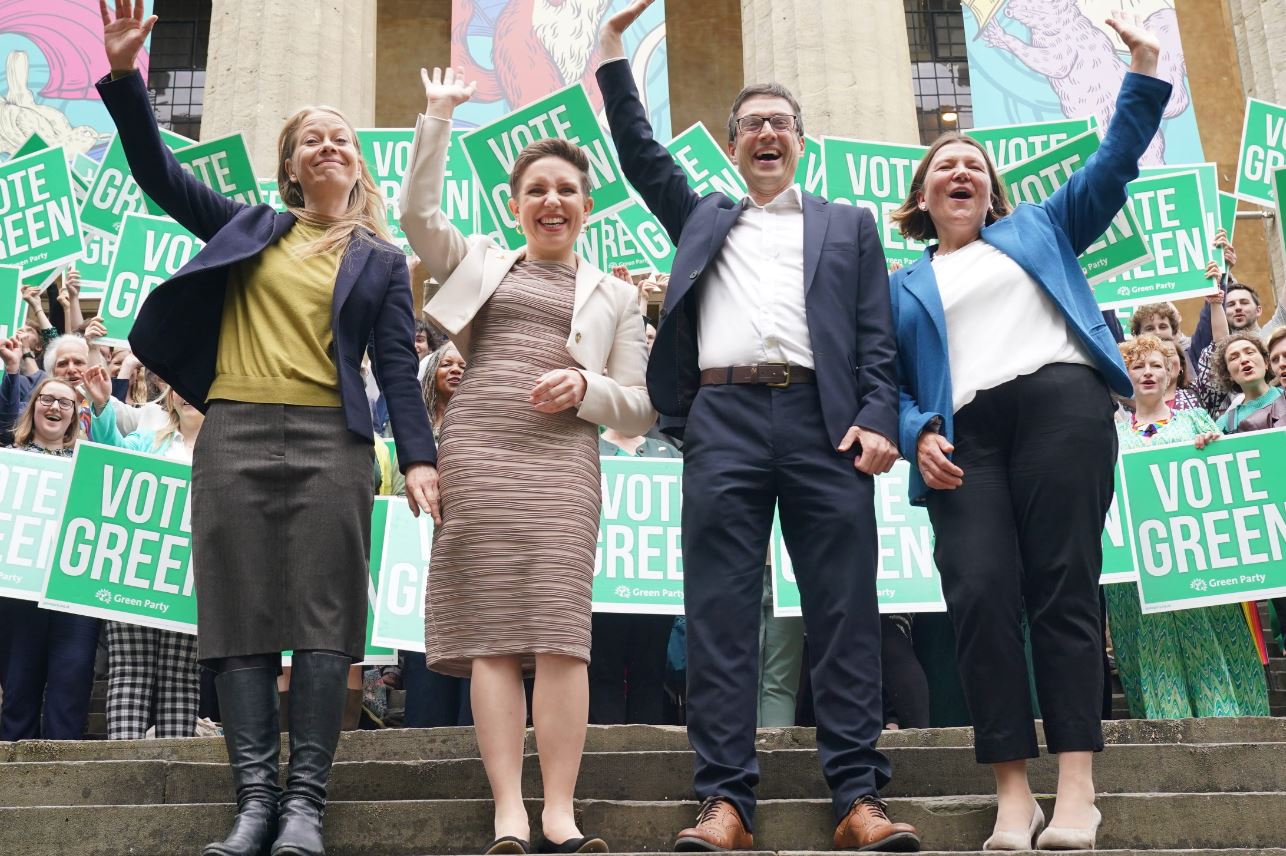
How the Greens bounced back from defeat and became the party of the urban left
Article made possible by my amazing patrons, including: Mick McAteer, Jo Bird, James, Duncan Black, Joseph Bailey, Alex Wilson, Bert Rothkugel, Nicholas Martin, Chris Gravell, Ben, Uditha Desilva, Thomas Alexander, Stephen Kaar, Ruth Holliday, Jane Turner, Konrad, Patrick Lefevre, Scott Folan, Neil Barton, Mohammed Mumit.
In May 2015, the Green Party achieved their best result up to that point. For the first time since the late 1980s, the party polled over 1 million votes in a national first-past-the-post (FPTP) election, and came within a few percent of winning a second seat (in Bristol West). Yet even though its aggregate vote rose overall, the party’s electoral coalition remained much as it had for the previous few decades: rural, southern, white and middle class. All they got out of it was one MP, but they had hopes of winning more.
Two years later, this traditional ecologist coalition disintegrated after Corbynism swept it aside. After a failed attempt to revitalise their traditional voter base in 2019, the Greens moved on to building a new electoral coalition – one more durable and diverse than the white rural voters that had made up the bedrock of their support since the 1980s. And in the aftermath of the 2024 election, it is very clear that they have succeeded beyond their wildest dreams.
Not only did the party increase its vote share to 7% (objectively an incredible result for a small party under FPTP), but they also won four seats in the House of Commons – the most seats won by an independent left-wing party since the ILP in 1935. This success was built on a radically transformed electoral base, with the party’s southern rural base replaced by a young, diverse urban electorate based in London and the North of England. After 2015, the party’s major targets were overwhelmingly white and middle class (like the Isle of Wight); after 2024, their main target seats are working class and racially diverse (like Huddersfield).
In this article I will examine how the Greens were transformed, and explain how the old demographic stereotypes about the party are thoroughly outdated. Far from being the party of white, middle class centrist liberals, the Greens’ 2024 coalition is far more like that of Jeremy Corbyn’s electoral base in 2017 and 2019 – and their policies reflect it.
Defeat and Disappointment (2015-19)
In mid-2019, the Greens seemed ready for a revival. Buoyed by anti-Brexit sentiment, the party had gained over 200 council seats in the May elections, had won 7 MEPs in the EU elections, and was polling at a record 8% (and often higher in some surveys). After 4 years of poor results due to Corbyn’s Labour monopolising the left vote, the party looked likely to return to prominence and perhaps gain a seat in Parliament.
Unfortunately for them, this proved to be a false dawn. As the election drew closer, and Corbyn’s Labour embraced a second EU referendum, the Green Party vote declined steadily until they were polling little more than their 2017 result. In the December 2019 election, the party increased its vote share by a single percentage point, and was crushed in all of its target seats except Brighton Pavilion. In Bristol West, their number one target, they lost by a margin of 28,000 votes. For the Greens, the 2019 election was a disaster.
What went wrong? Corbyn monopolising the left vote was a factor, of course. But perhaps more significant was the fact that the Greens were trying to revive an electoral coalition that had long since shattered into pieces. Since the 1980s (when they won over 2 million votes in the European elections) the party had always been strongest in the South of England, winning votes from liberal-minded voters in rural areas and university towns. Indeed, even in 2015 a majority of Green votes came from ‘county’ (rural) constituencies.
Yet in 2017 and 2019, attempts to mobilise the apparently successful 2015 coalition flopped because the world had changed. Polarised by Brexit, rural areas swung to the Tories or Lib Dems, while university towns and cities embraced Corbyn and his left-wing manifesto. With the Greens unable to distinguish themselves enough from Corbyn on economics or the Lib Dems on Brexit, the Green base left and didn’t come back. They needed a new one.
New Pastures (2019-21)
The election of Keir Starmer as Leader of the Labour Party was a gift to the Greens. Despite running on a left-wing policy platform, Starmer quickly abandoned it, firing and expelling left-wingers and even suspending Jeremy Corbyn himself. Yet the Labour Left, rudderless and leaderless, refused to launch an alternative party. A few hesitant attempts from Corbynite activists (Breakthrough, Transform, Northern Independence Party) to build a third party ultimately went nowhere. With millions of left-wing voters eager for an alternative, the field was left wide open for the Greens, and they seized it with both hands.
After a period of uncertainty about their direction, in 2021 the party elected Bristol councillor Carla Denyer and sustainability charity CEO Adrian Ramsay to lead them. Denyer and Ramsay ran on a platform recognisable to any Corbynite: opposition to capitalism, support for transgender rights, supporting a universal basic income, backing renters’ rights and “putting compassion back in politics”. They were elected with 62%, with the duo of climate activist Tamsin Omond and deputy leader Amelia Womack taking second place.
While not the most left-wing candidates in the race (Omond and Womack arguably ran the most left-wing campaign), Denyer and Ramsay did not lead the party as moderates. As Keir Starmer led Labour to the right, the Greens’ new leadership led them to the left. Under Denyer/Ramsay the party championed the cause of Palestinian human rights, called for nationalising water companies, demanded higher taxes on the rich, proposed an end to austerity and pushed for repealing all anti-union legislation. With no Corbynite party moving to occupy the left of British politics, the Greens took that space for themselves.
Voters noticed.
Breakthrough (2021-24)
In May 2019, the Greens had experienced a shock surge in local councillors. But there were reasons to think was a one-off. The major parties were historically unpopular at the time, voters were angry over Brexit (on both sides) and the party was ultimately crushed in the 2019 general election. It was not a given that they would keep making gains.
But they did.
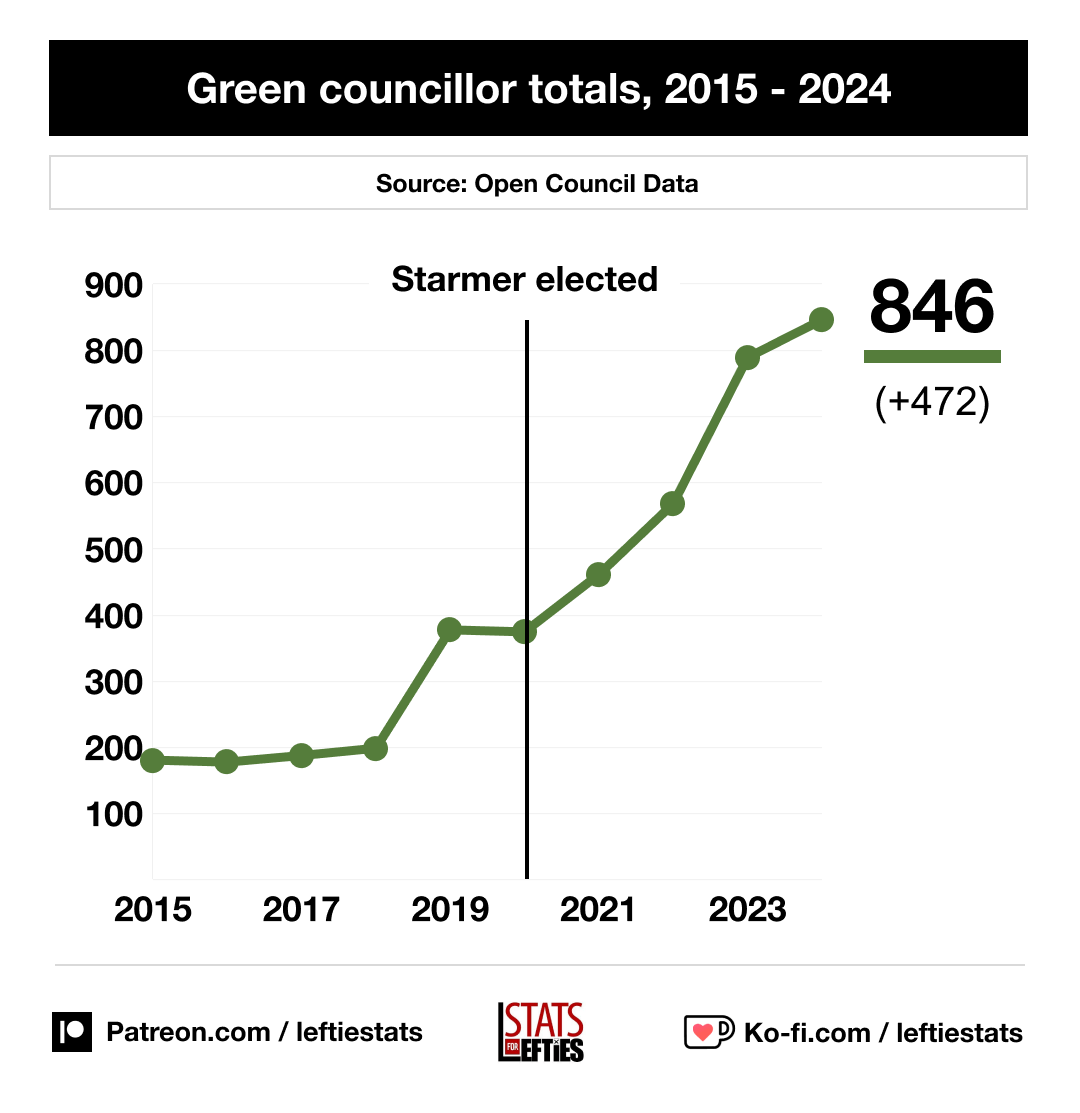
Starting in 2021 and accelerating after Denyer/Ramsay were elected, the Greens began to make impressive gains in local government as Starmer pushed Labour to the right. Between 2020 and 2024, the Greens increased their total councillors from 374 to 846 (+472), taking the leadership of half a dozen councils and winning a majority in the district of Mid Suffolk. While they lost Brighton and Hove City Council due to local circumstances, they made up for it by winning minority control of multiple other councils in 2023 and 2024. The party now leads a record 11 local authorities, up from just one in 2020 (subsequently lost).
More importantly, the composition of the Greens’ councillor base was transformed. Prior to the 2021 elections, the Greens had just 99 seats on local authorities led by Labour. After the 2024 elections, the number of Greens on those same councils has risen to nearly 300.
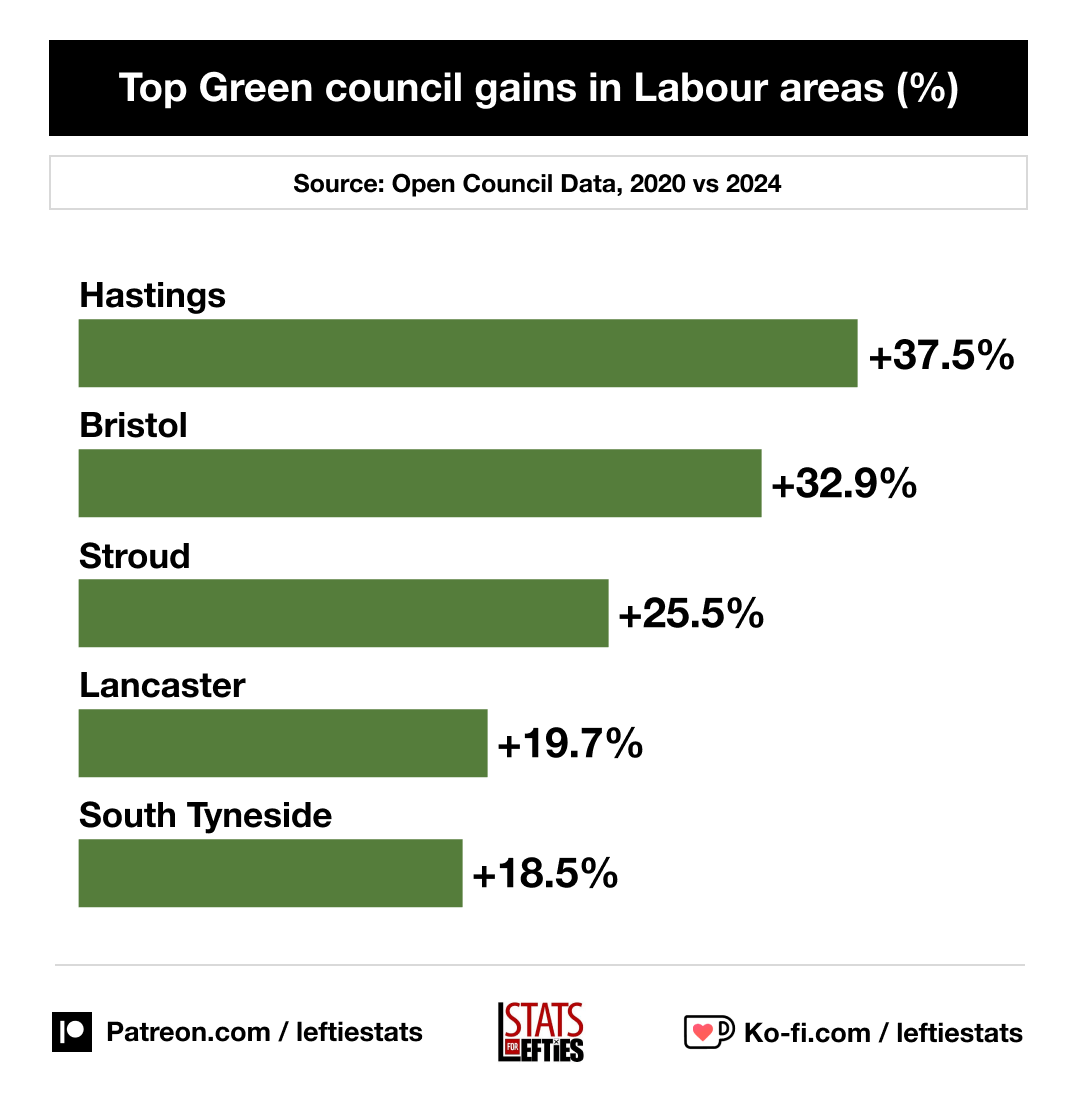
Many of the Greens’ most significant gains have been in Labour-led councils, such as Hastings (+37.5% of seats), Bristol (+32.9%), Stroud (+25.5%), Lancaster (+19.7%), South Tyneside (+18.5%), Wirral (+18.2%) and many more.
Far from being a party of rural conservatives as some claim, the Greens have in fact dramatically expanded in progressive urban areas. In 2020, the party held just 73 seats on Labour-led urban councils; by August 2024, this had risen to over 200 (+185%)
This shift was particularly pronounced outside of the party’s traditional strongholds in southern England. In the south-east, the party gained a mere 3 seats in urban areas, but in the north-west, the party gained 41 seats (+164%). In Lancaster, the Greens went from just 10 councillors to 22 (+12) in four years, and are currently the largest party.
That said, the party’s biggest urban success was in the south-west: namely Bristol, where Greens went from 11 seats to 34 (+23) and took minority control of the council – and subsequently were allocated Bristol’s seat on the West of England Combined Authority.
In short, even before the 2024 general election, the Greens’ success in urban left-leaning areas was increasingly clear. But few expected it to show up in the 2024 general election, due to the national ‘Get The Tories Out’ mood and the electoral system.
They were wrong.
The Green Tide (July 2024)
When the 2024 election was called, the Greens would have understandably been nervous. They were averaging 5.6% (not bad) but the past three elections had also seen the party start the campaign with strong poll figures, only for these numbers to erode substantially by the time people actually voted. With the country desperate to vote the Tories out, there was good reason to believe that this would happen again.
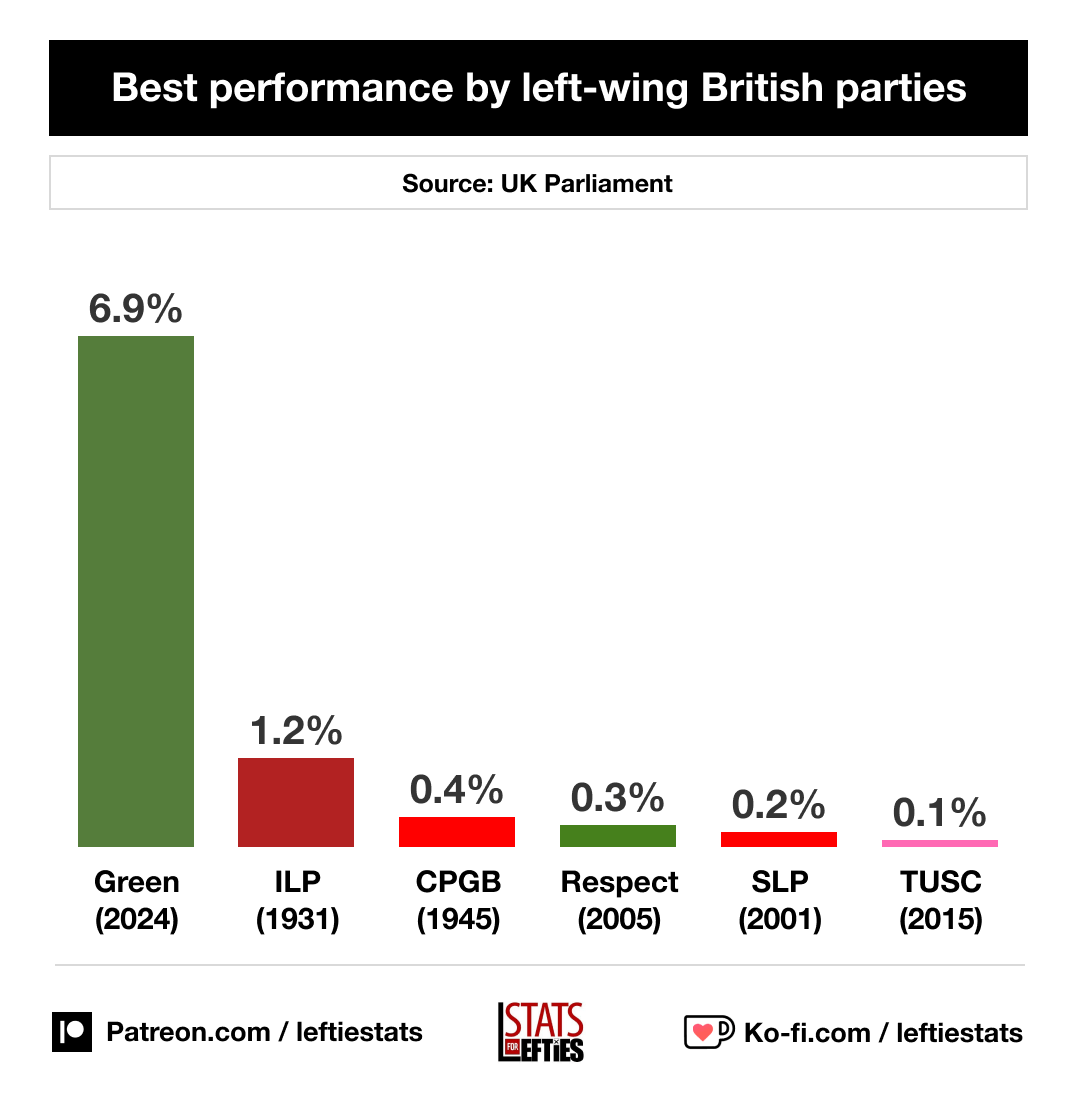
And yet, to everyone’s surprise, their vote did not go down. Instead, for the first time in its history, the Green Party actually outperformed its pre-election polling. On election day, 1.9 million people in Great Britain cast a ballot for a Green (6.9%), exceeding their pre-campaign polling by 1.3pts.
In the history of Britain, no other left-wing party has ever won that many votes. No other left-wing party has even come close. Respect, the Communist Party of Britain, Socialist Labour, TUSC, the Independent Labour Party – even at their peak, none of these significant left groups ever even got above 1.2% of votes at a general election. Greens won 2 million votes (7%).
The Greens won over 5% of the vote in every region of England, and came close to doing so in Wales too. In Scotland, the Scottish Greens ran in around 8 in 10 seats and won less than 4%, but still achieved impressive results in urban areas like Edinburgh and Glasgow.
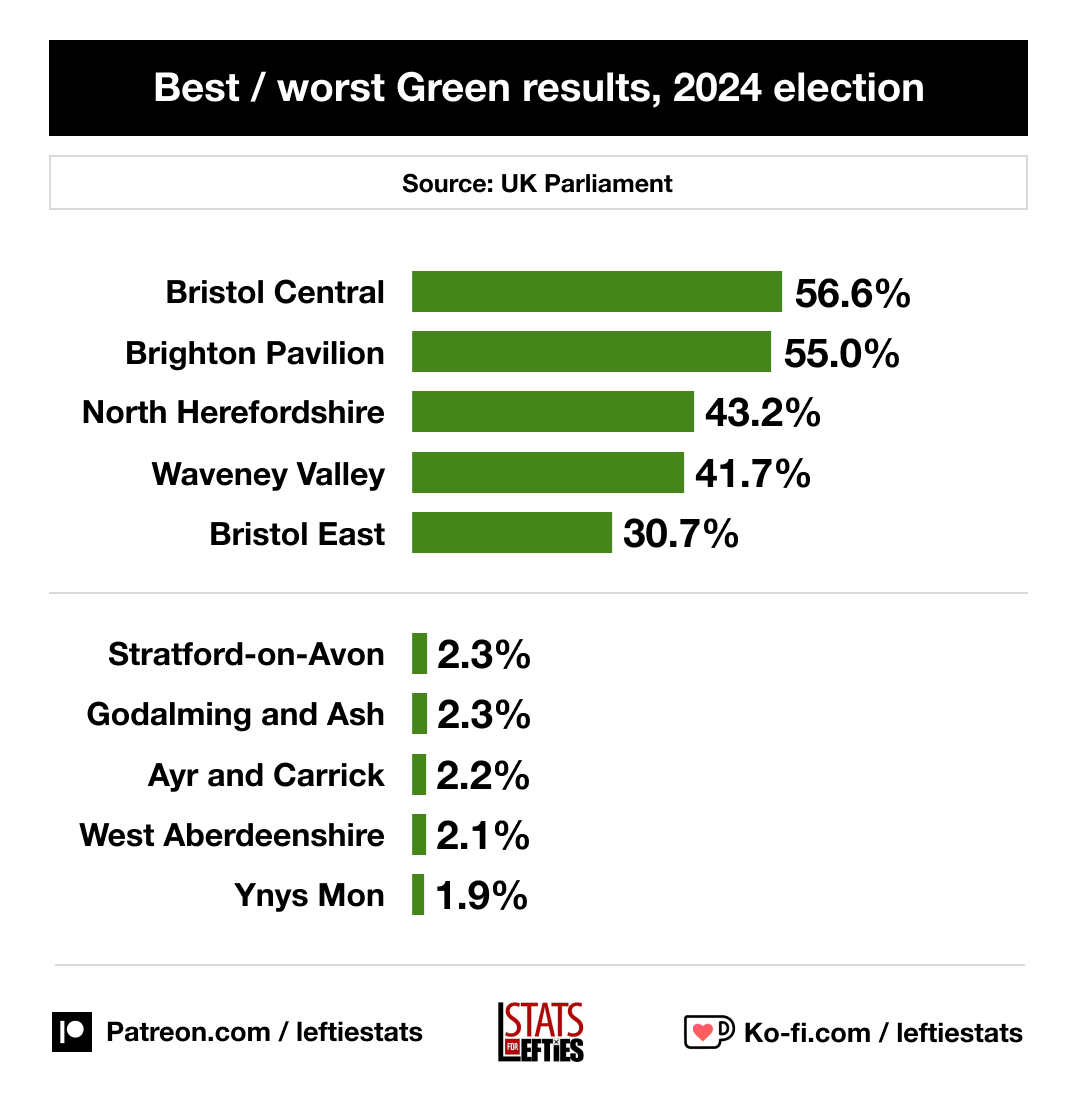
More notably, despite multiple pollsters and MRPs predicting that the party would be wiped out entirely, the Greens held onto Brighton Pavilion by a landslide margin and added three new seats to their tally: North Herefordshire (from CON), Waveney Valley (from CON), and Bristol Central (from LAB). All of these victories were shocking in their scale.
Brighton Pavilion
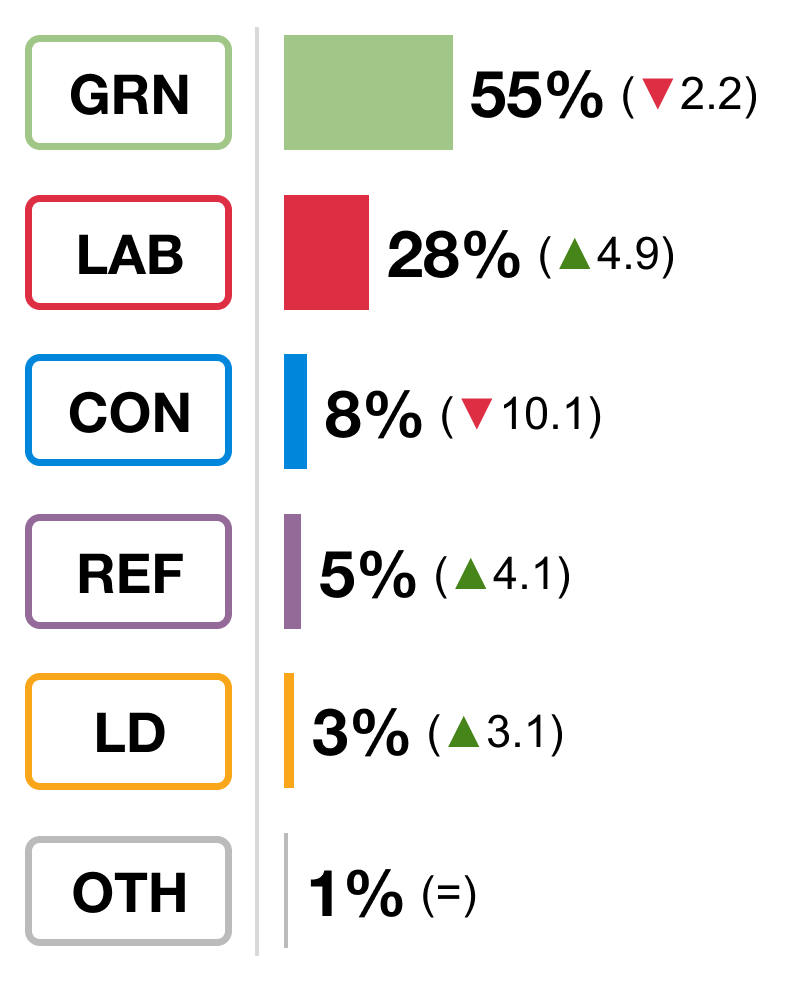
With Caroline Lucas stepping down in Brighton Pavilion, and with the Greens wiped out in Brighton council elections in May 2023, pollsters and pundits predicted a close contest or – in some cases – an overwhelming Labour victory. Yet on election night, the new Green candidate Sian Berry stunned critics by winning 55% of the vote, an absolute majority and a crushing victory way bigger than anything Lucas achieved in 2010, 2015 or 2017.
North Herefordshire
One of the longshot targets for the Greens was North Herefordshire, which had the distinction of sitting in the West Midlands – outside of the party’s traditional comfort zone in southern England. On top of that, it was an ultra-safe Conservative seat where the Greens came fourth in 2019 (although they did save their deposit).
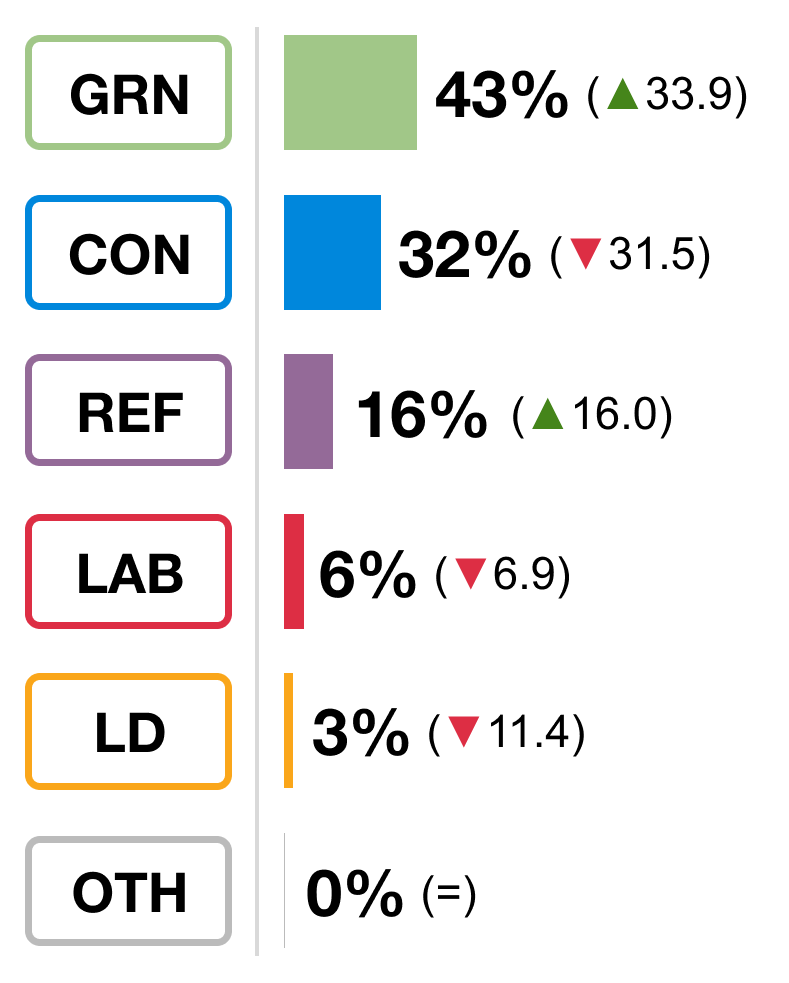
Yet on election day, a phenomenal campaign led by Green candidate Ellie Chowns saw the Greens leap from 9% of the vote to a whopping 43% (+34pts).
Waveney Valley
Like North Herefordshire, Waveney Valley was a safe Tory seat but it was less of a longshot target for the Greens. The party decisively won it in the 2023 local elections, and it is home to the first majority Green local authority in Europe (Mid Suffolk). On top of that, the party picked co-leader Adrian Ramsay as their candidate. Yet polls disagreed about who was best-placed to challenge the Tories in this seat, and the Tory majority was sizeable (35pts).
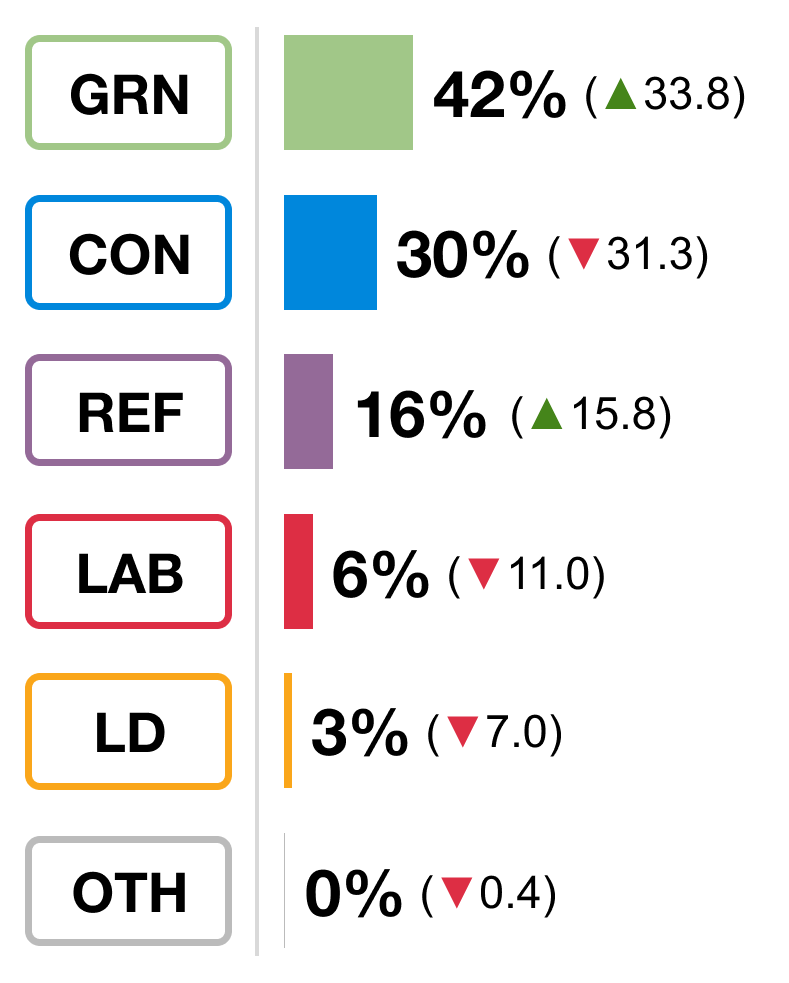
However, in the end it wasn’t close. Ramsay won with 42% of ballots (+32), a clear majority of 5,600 votes (11.4%).
Bristol Central
The three Green wins above are decisive and impressive, but the party’s triumph in Bristol Central was astonishing. For over 10 years the Greens have targeted the seat and its predecessor (Bristol West), which was held by Labour’s Thangam Debbonaire. After falling just short in 2015, the Greens were utterly crushed in 2017 and 2019 by landslide margins. Labour supporters were confident that their party would easily retain the seat for a fourth election in a row. Many MRPs suggested the same.
Yet on election night, Labour lost by 10,000 votes. Carla Denyer, co-leader of the Greens, won a stonking 57% of votes (+31pts), with Debbonaire winning a pitiful 33% (-26pts). The Green victory was so overwhelming that it almost carried the party to another win in the neighbouring seat of Bristol East, with the party increasing its vote share by 22pts despite focusing all of its efforts on Bristol Central.
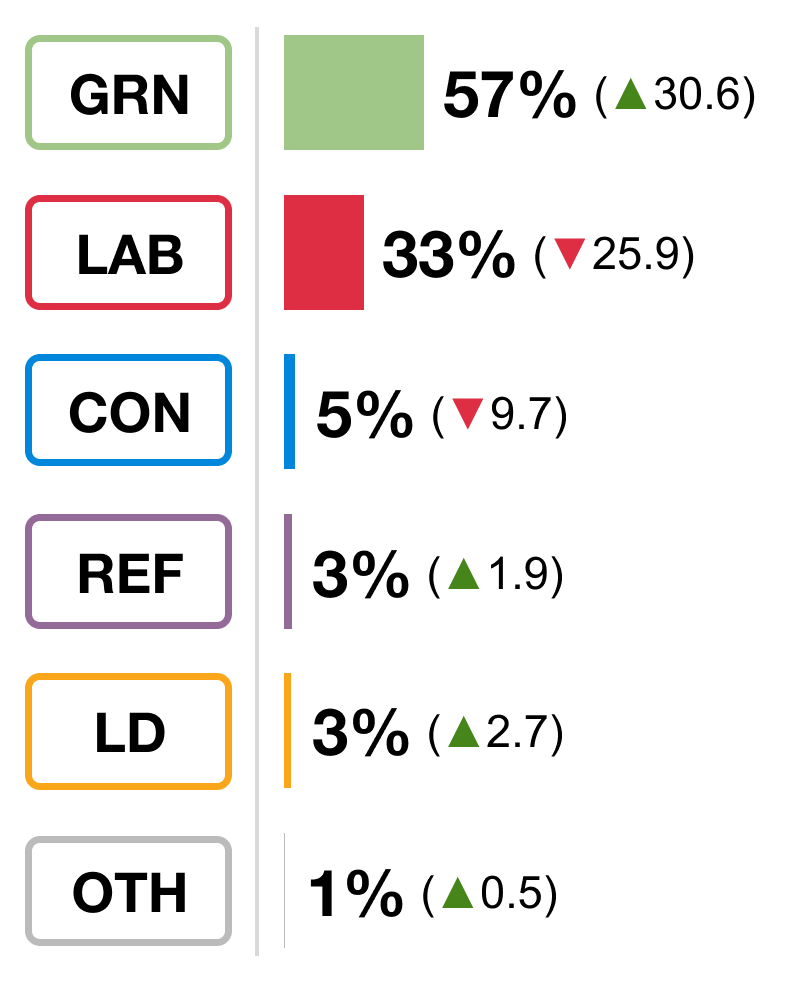
The result stunned Labour supporters, who assumed that the three-time winner Thangam Debbonaire (who had a majority of 28,000 votes in 2019) was unbeatable. But as I have explained many times, these landslides were illusory. Labour’s massive 2017/19 margins in places like Bristol were built on the back of Corbyn’s popularity amongst urban voters, people of colour and socially liberal progressives, who embraced him even as the country rejected him. With Corbyn and his politics expelled from the party, I argued repeatedly that places like Bristol would revert to their 2015 partisan alignment (all other things being equal). As you saw, they did far more than that. But I’m getting ahead of myself.
A Coalition Remade (2024)
In July 2024, the Greens won around 800,000 more votes than in 2015 (+3pts). On the face of it, this might seem like a modest advance. But beneath the surface, the Greens had remade their electoral base – making it more ideologically left-wing, geographically even, more demographically diverse and more concentrated amongst particular demographics.
Ideology
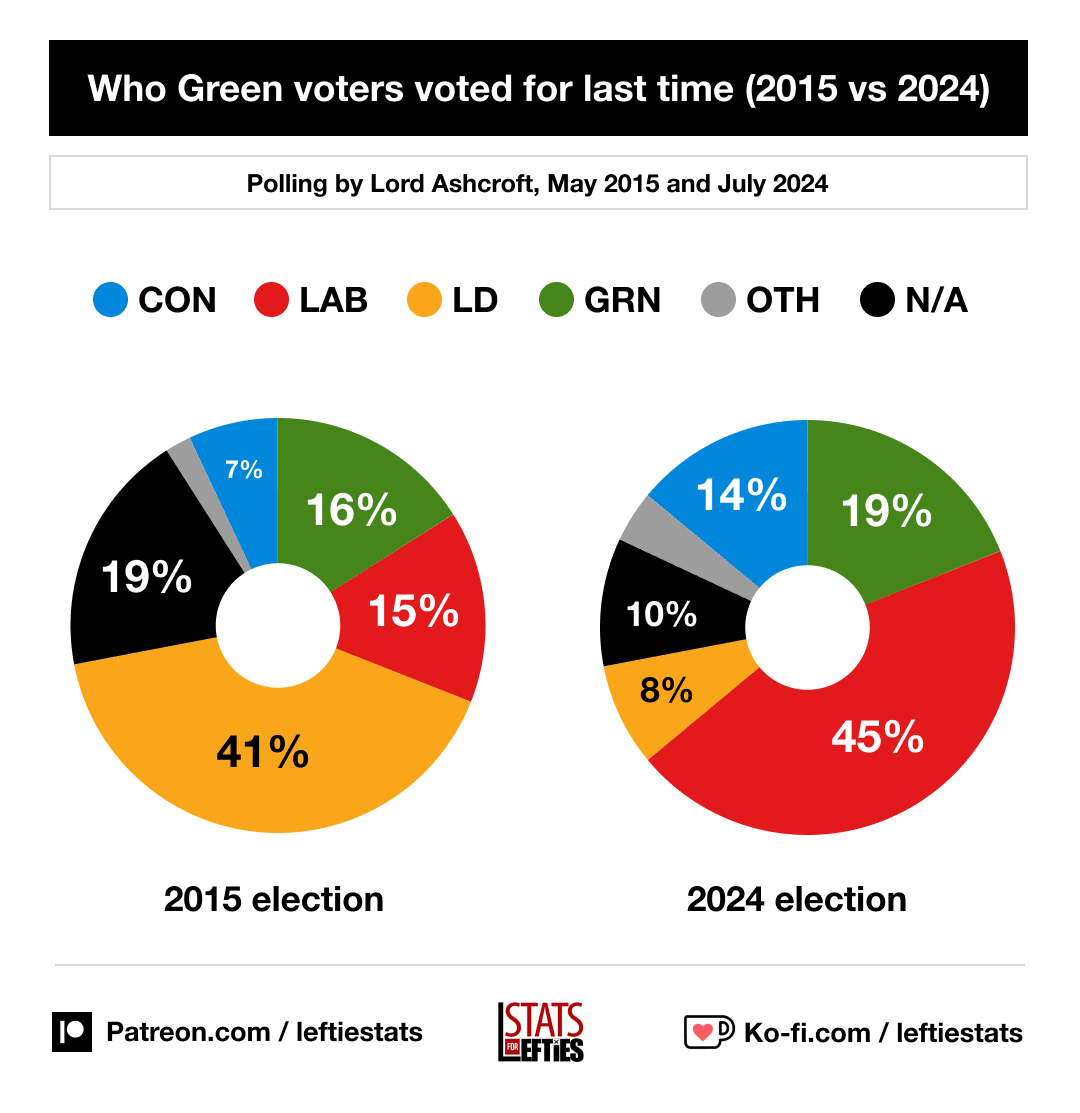
In 2015, the Green electoral coalition was heavily dependent on centrist voters. A whopping 48% of their 2015 supporters had voted Liberal Democrat or for David Cameron’s Conservatives in 2010, with just 15% for Labour under Gordon Brown (16% voted Green).
By 2024, the Green base had shifted firmly to the left. 45% of the Greens’ 2024 supporters voted for Corbyn’s Labour in 2019, with just 2 in 10 voting Lib Dem (8%) or Tory (14%). Just 19% of the party’s 2024 supporters had backed the Greens in 2019, with the party shedding over 40% of its 2019 backers to Labour and the Liberal Democrats. Yet the supporters they won from Labour proved to be far more electorally effective than the ones that they lost, as you will see below.
As a result of losing centrist voters but gaining hundreds of thousands of left-leaning Brits, the Green base is now the most left-wing electoral alliance in British politics. Amongst 2024 Green voters, 78% say feminism is a force for good; 77% approve of multiculturalism; 71% have a positive opinion of social liberalism; 70% think immigration is positive; and only 19% think capitalism is a force for good (54% say negative).
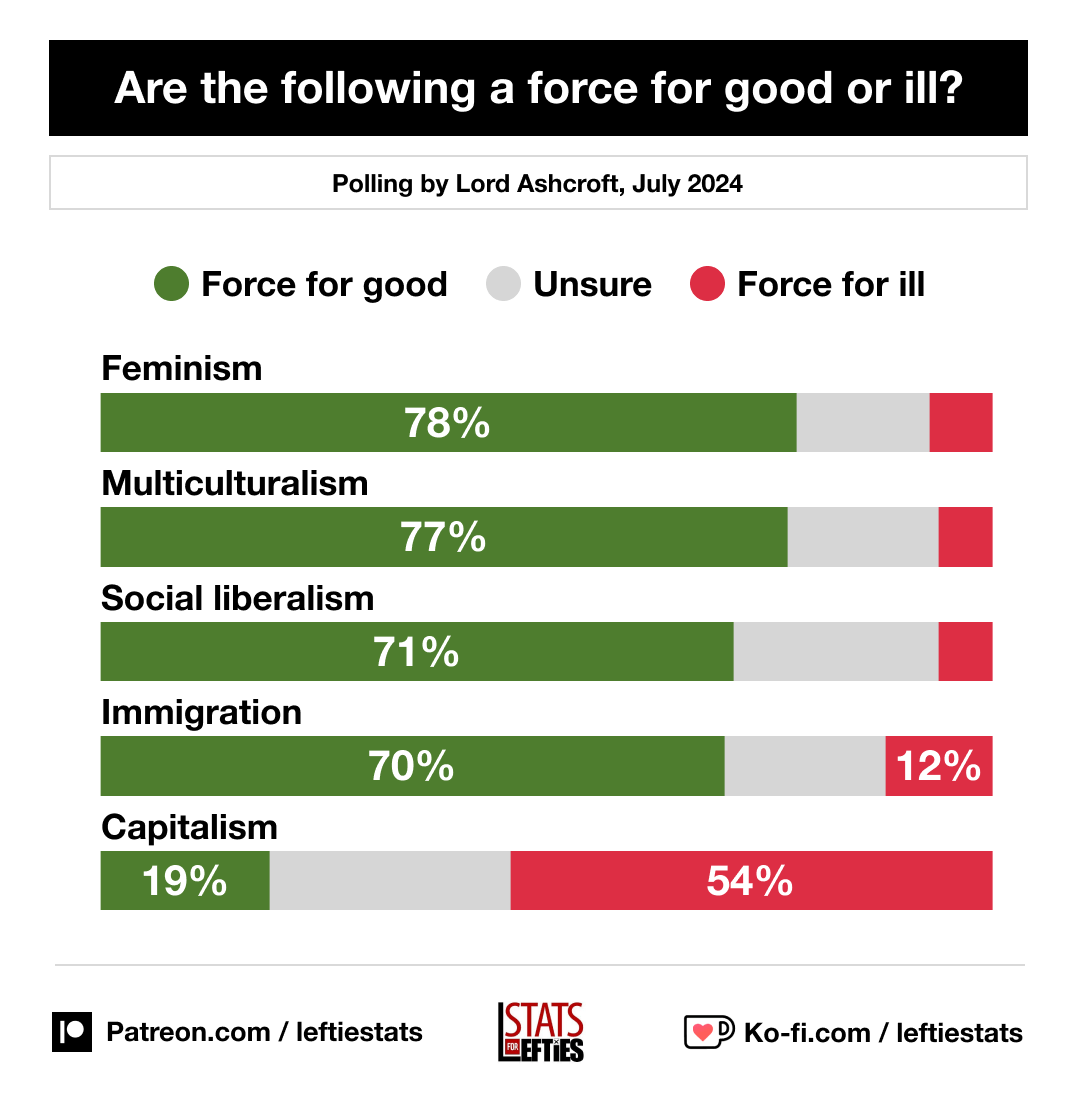
Green voters’ opinions of capitalism are notable; in 2019, net approval for capitalism amongst Greens was -12. Amongst the new Green electorate, net approval is -35. The Greens have actively courted left-wing voters abandoned by Starmer and Labour; the 2024 result suggests that even in the face of an overwhelming “tactical voting” push from Labour supporters, the Greens still won over the left electorate.
Geography
It’s not just the ideological composition of the Greens’ support base that changed, however – its geographic makeup has been altered too. In 2015 the party was mainly a force in the rural south; a majority of its votes came from rural constituencies, and it won 5% in the south of England (excluding London) compared to a miserable 3% in the north.
Its strongest counties were mostly southern and rural: East Sussex (10%), Avon (9%), Oxfordshire (6%) and others. In mainly urban counties like Merseyside (3.6%), Greater Manchester (3.5%) and South Yorkshire (2.7%), the Greens flopped. Of the top ten counties, 8 were in the south.
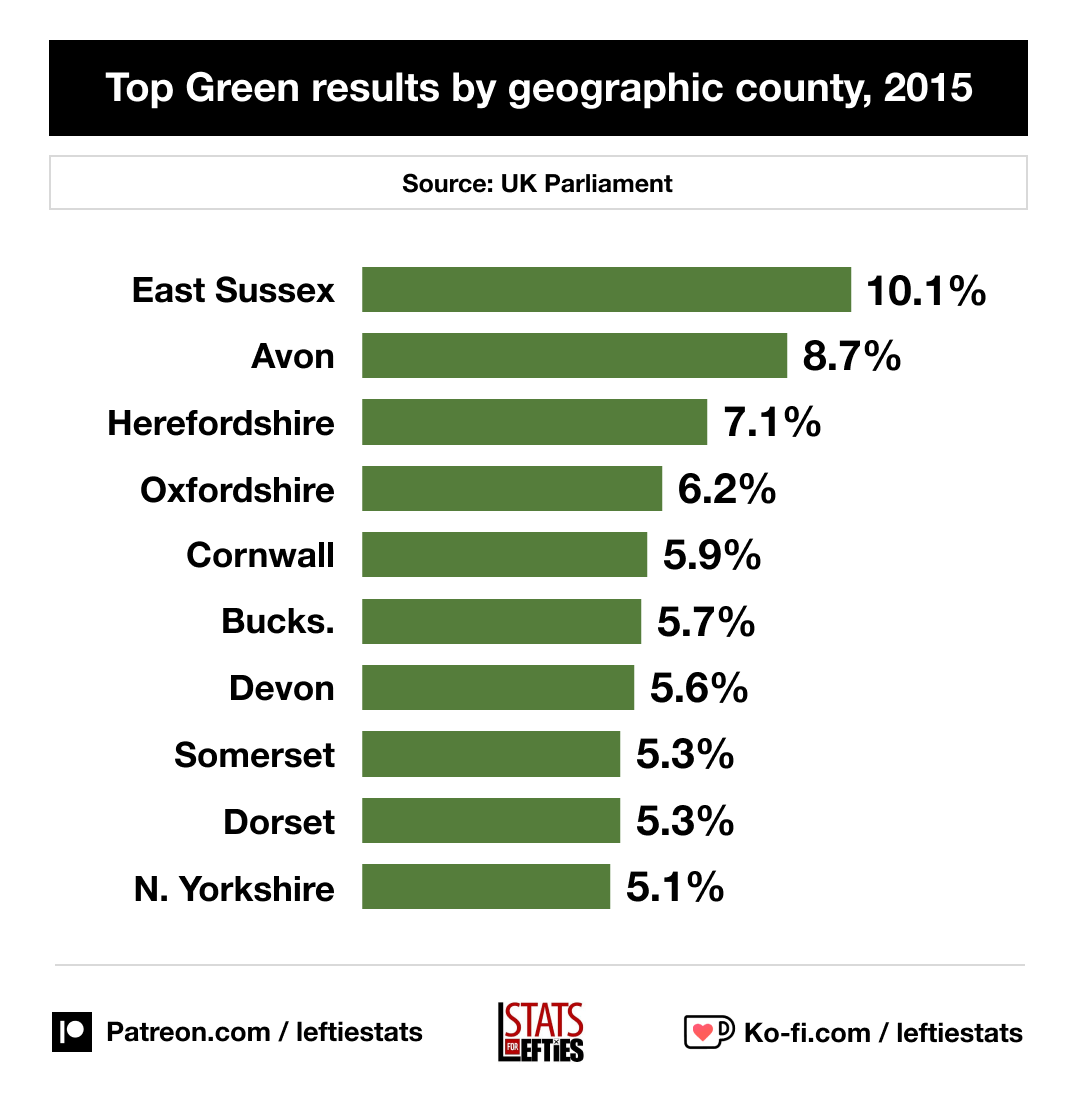
9 years later, these trends have been reversed. Under Denyer and Ramsay in 2024, a majority of Green votes came from urban constituencies, and their vote share in the south (7.04%) was virtually identical to their vote share in northern England (6.99%). Remarkably, for a party once labelled “Tories on bikes”, the Greens won more votes in Yorkshire and Humberside (7.5%) than in leafy rural East Anglia (6.9%).
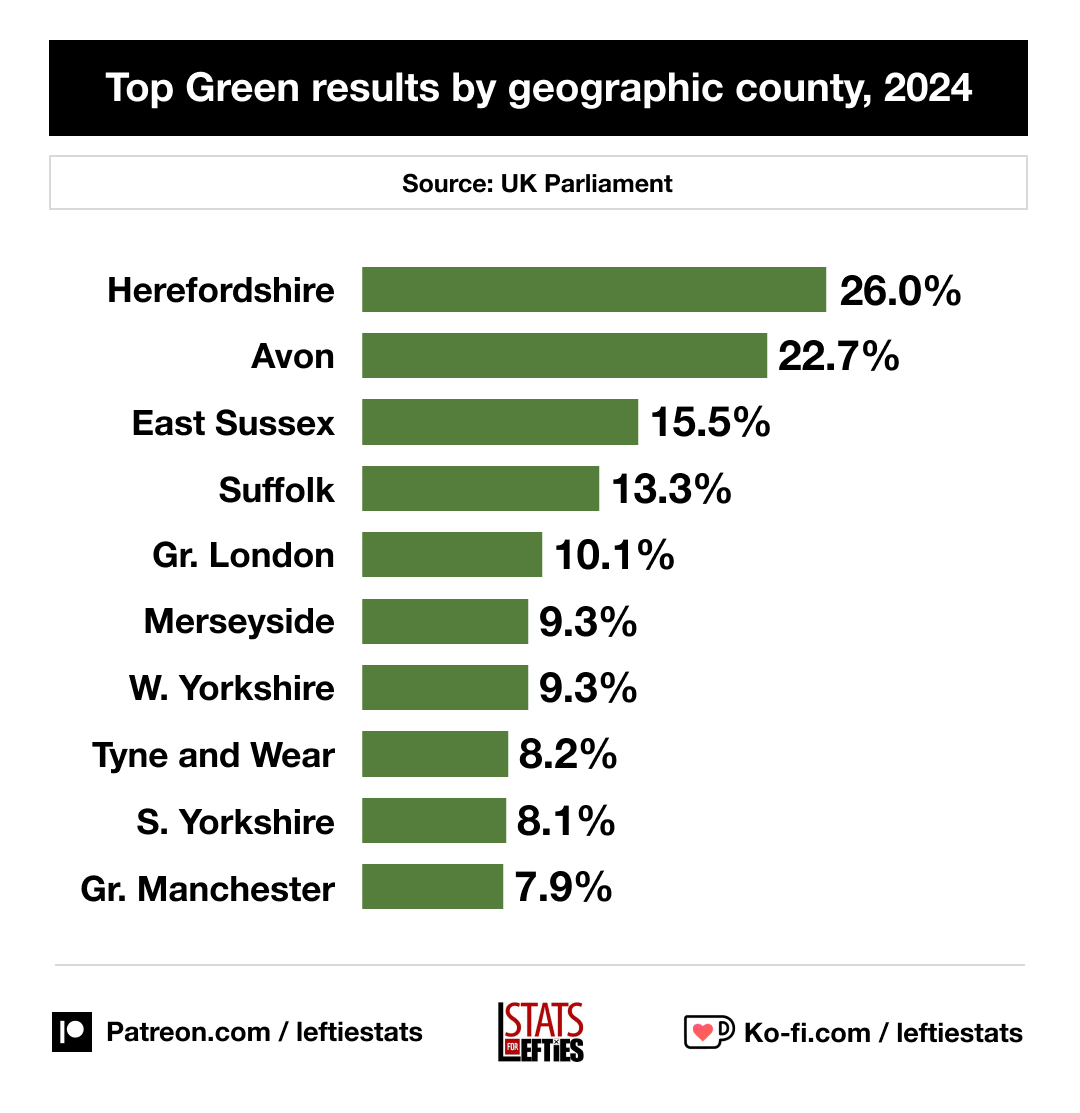
At county level, its results were transformed. Just three of its top 10 county results were southern counties; meanwhile Merseyside (9.3%), South Yorkshire (8.2%) and Greater Manchester (7.9%) saw enormous surges in Green support. In London, the Greens won over 300,000 votes (10%), racking up almost as many votes as the Liberal Democrats. Even at the party’s previous high point in 2015, the Greens had failed to surpass 5% in London. This time they easily surpassed twice that figure. Overall the Greens won over 5% of the vote in 34 English counties, just 18 of which (53%) were in the south.
Demographics
In 2015, the Green electoral coalition was not particularly diverse. They did slightly better amongst younger voters and renters, but overall their vote share amongst various groups was pretty even. They polled higher with white voters (4%) than people of colour (3%), while performing just as well with social renters (3%) as those who own their home fully (2%). Their best results, meanwhile, were found mainly in white and/or rural constituencies: 13% in the Isle of Wight (97% white), 12% in Bath (92% white) and of course Brighton Pavilion (85% white). Amongst rural voters, the Greens received 4% – urban voters, 3%.
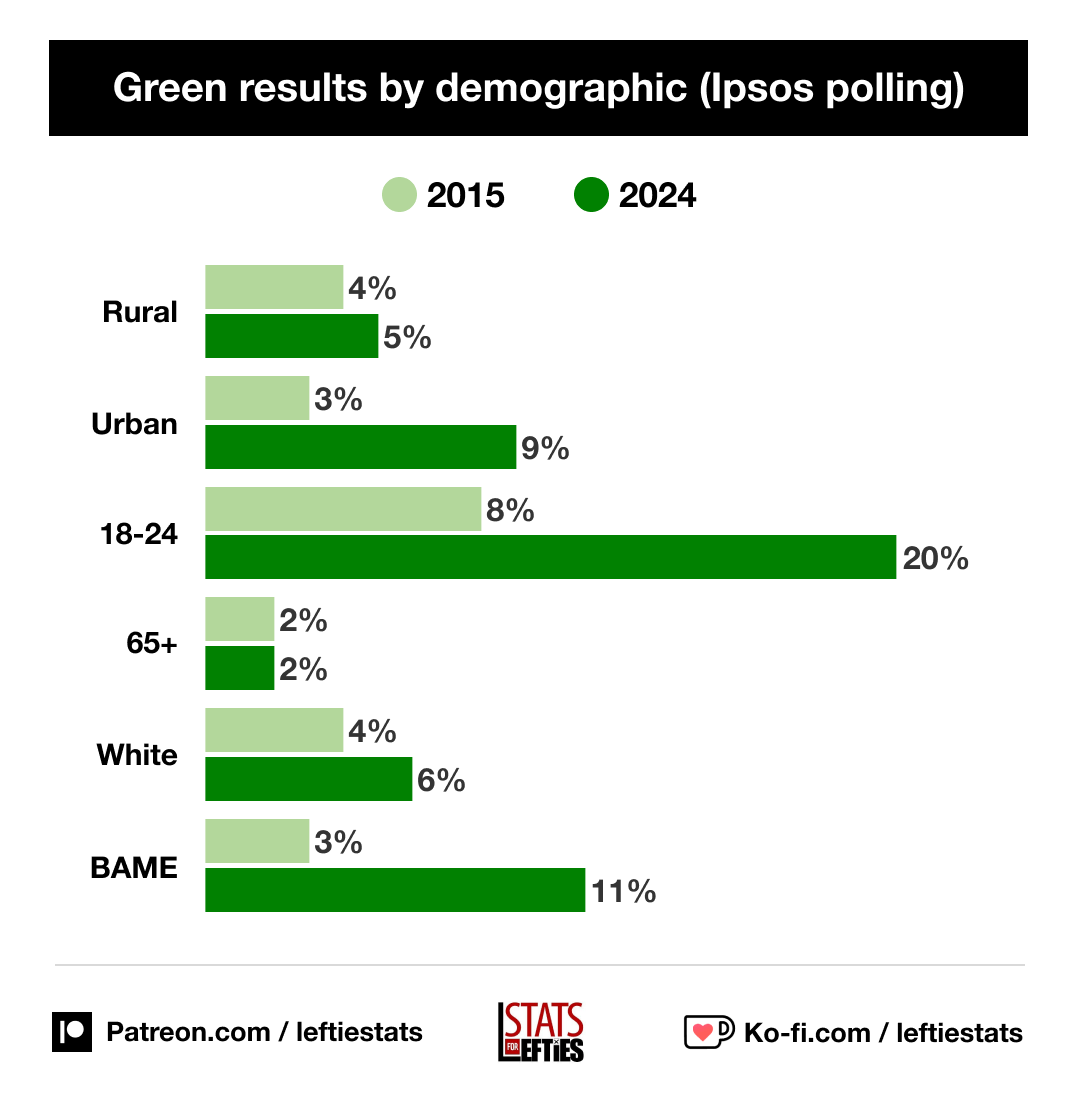
In 2024, the Greens’ electoral base is completely different. The party’s support amongst young voters is now a whopping 20% (+12pts since 2015), while its support amongst BAME voters (11%) is much higher than its support amongst white Brits (6%). Indeed, Greens are now the most racially diverse party, with 87% of its voters identifying as white (compared to 92% for Labour). Support with social renters (8%) is twice that of homeowners (4%), while support in urban areas (9%) is almost double that of rural areas (5%).
In effect, the Green electoral coalition in 2024 is significantly younger, far more racially diverse, much poorer and more urban than in 2015. This diversity was reflected in their constituency results. They received over 20% of the vote in urban seats like Huddersfield (61% white), Sheffield Central (63% white), Manchester Rusholme (38% white) and Hackney South (33% white). By contrast, they received just 2% in rural seats like Stratford-on-Avon (95% white), Godalming and Ash (94% white) and North Shropshire (95% white).
Efficiency
In 2015, the Greens did not exceed 10% with any demographic group. Even amongst young voters, their best demographic, they got a mere 9% of the vote. This widely distributed broad support cost them in terms of constituencies: they fell far short in every seat aside from Brighton Pavilion, and received over 10% of the vote in a mere 18 seats.
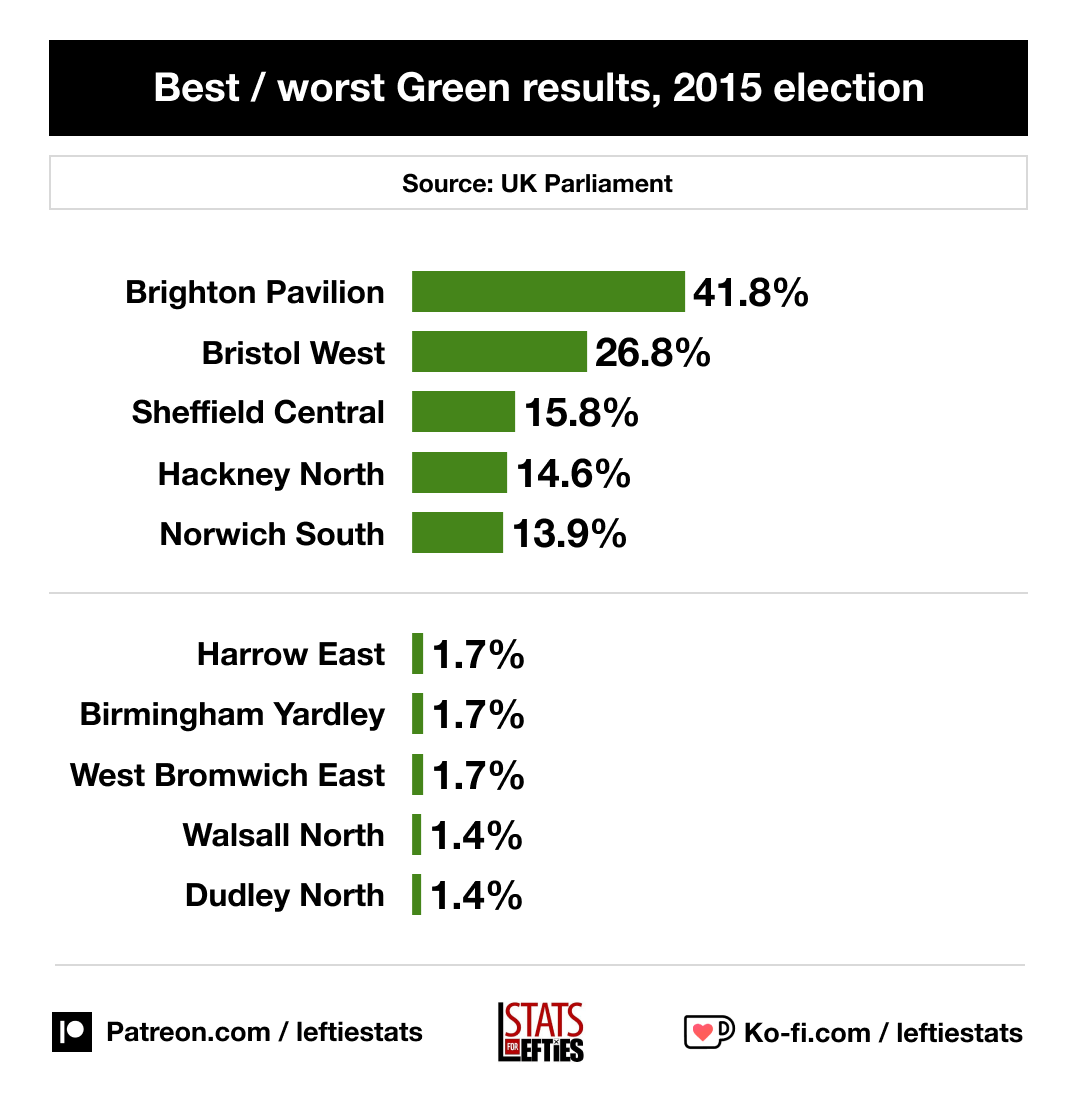
In 2024, the Green vote was substantially more efficient. Despite receiving only 800,000 more votes than in 2015, the party’s vote is now far more clustered in particular seats. In 2024 they received over 10% of the vote in 108 constituencies (up from 18 in 2015), and received over 20% of votes in 15 constituencies (up from only 2 in 2015). This was partially due to effective organising, but it’s not the full story.
The major reason for this increased vote efficiency is that the Green vote is no longer broad, but concentrated amongst particular demographics. The party is now far stronger with young people (20%), BAME people (11%), urban voters (9%) and renters (12%) than other demographics – and as a result, it saw big increases in vote share in constituencies where these groups are over-represented.
In other words, the Greens’ focus on left-wing voters paid off: the party is now in a strong position to gain up to ten additional seats in 2029, whereas following the 2015 election they could only really hope to gain one extra seat on a good day (Bristol West). Half of these target seats are in the North of England, and all of them are in urban areas.
Conclusion: Watermelons Rising
Just over a decade ago, the Greens debated a key resolution at their party conference. The motion aimed to amend the party’s core values (its ‘Philosophical Basis’) to shift it fully to the left, deleting a passage that blamed all humanity for climate change and instead shifting the blame for global warming onto capitalism specifically. This was a hotly debated proposal, and I should know: I was there. I remember standing up, hands shaking with nerves, and arguing in front of the whole party that we should amend the philosophical basis so that it reflected our values as a left-wing anti-capitalist party. It passed.
Ten years down the line, the Greens have fully embraced the values expressed in that Philosophical Basis: “A system based on inequality and exploitation is threatening the future of the planet on which we depend … A world based on cooperation and democracy would prioritise the many, not the few”. That last line, echoing Jeremy Corbyn’s 2017 manifesto, is key. As the broken and hollowed-out Labour Left has hesitated and hidden itself away, the Greens have moved into the space once occupied by the Corbyn movement.
It was not a given that this would happen. Many left-wing activists feared that the Greens had been flirting with centrism in 2015-19, forming alliances with the Liberal Democrats and turning themselves from a Eurosceptic party in a Europhile pro-Remain campaign group. Whether fair or unfair, this characterisation took root, and the election of the centrist co-leader Jonathan Bartley seemed to confirm this shift. But in 2021 he (and left-leaning co-leader Sian Berry) quit the leadership, and were replaced by the Denyer/Ramsay duo who have subsequently embraced the left-wing values embodied by the party’s Philosophical Basis. Deputy Leader Zack Polanski has further added to this work. In doing so, they – and the party’s thousands of left-wing activists – have worked hard to rebuild the credibility of the party in the eyes of the Left. In large part, they succeeded.
In 2024, the Greens were rewarded for their shift to the Left with incredible electoral results far beyond their wildest dreams: four seats in Parliament, and almost 2 million votes. If I was to offer advice to the Green leadership, it would be this: your plan worked. Keep it up.