
Article made possible by my amazing patrons, including: Ben, Bert Rothkugel, Chris Gravell, Duncan Black, Jane Turner, Joseph Bailey, Konrad, Mick McAteer, Mohammed Mumit, Neil Barton, Nicholas Martin, Patrick Lefevre, Ruth Holliday, Scott Folan, Thomas Alexander, Uditha Desilva and Jo Bird
For the first time since 1982 (over 40 years ago), a third party has taken the lead in the average of British opinion polls. Back in 1982, that was the SDP-Liberal Alliance. In February 2025, the party leading the polls is far less liberal – because the current leading party is Nigel Farage’s Reform, a far-right anti-immigration populist party (the successor to the Brexit Party).
Just months after Keir Starmer led Labour to a 1997-sized landslide majority, the Prime Minister has decimated his party’s popularity. Twelve months ago, Labour led by 20 percentage points and was projected to win nearly 500 seats. Today, they trail Farage in polls and would win just 176 – their lowest share of seats since 1935. The government enjoys an approval rating of -40 across multiple pollsters, and Starmer’s own approval is almost as bad.
How did this happen? How could this happen? To sum it up in a few sentences is difficult, but if I were to make an attempt, it would be this: Labour told voters that if they backed them in the election, things would change. And then nothing changed. Indeed, things got worse.
20pts ahead no more
In February 2025, the average of polls was as follows (+/- vs the general election):
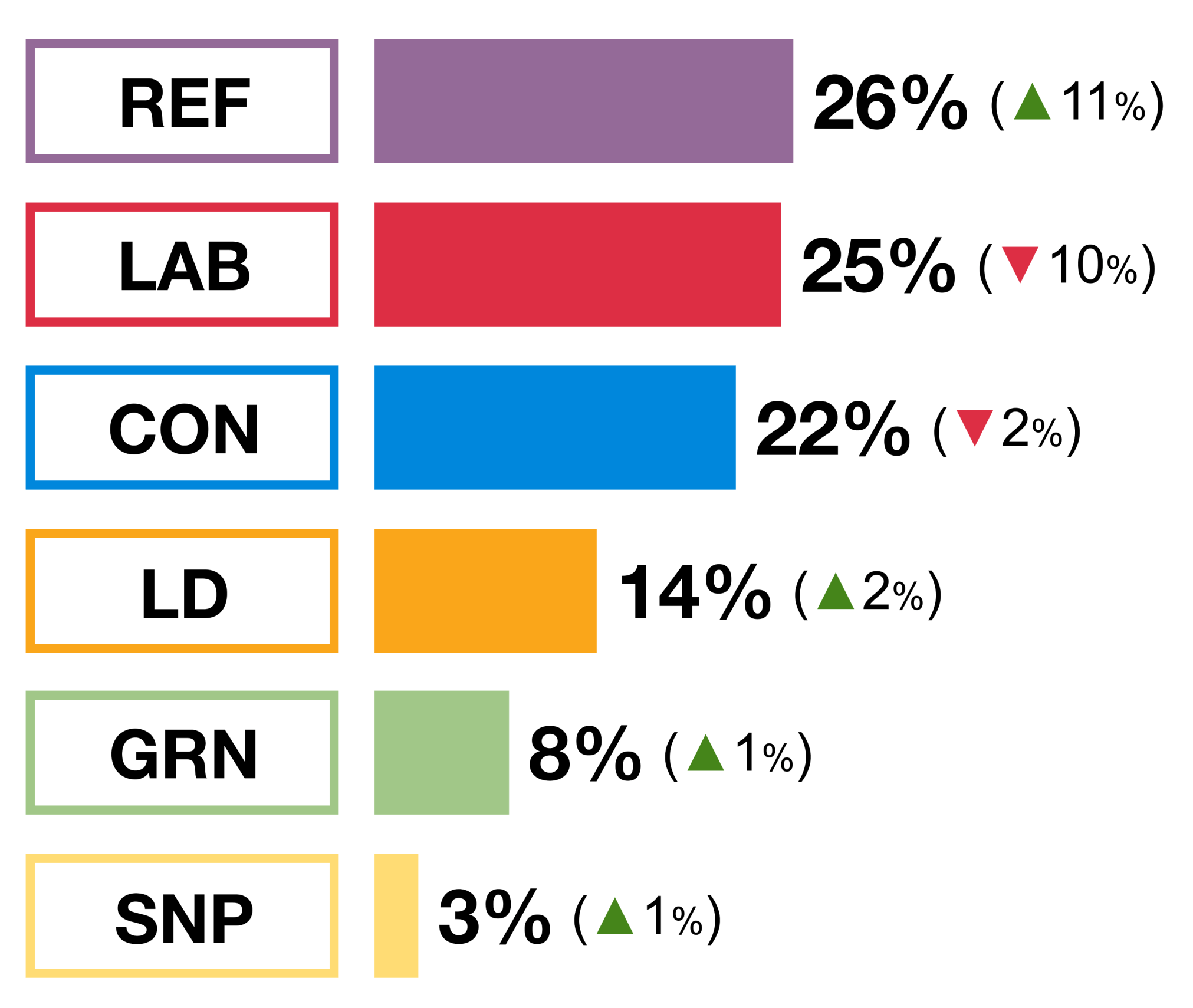
Since the general election in July 2024, support for Labour has continually fallen each month. It is now 10 percentage points lower than in the election, suggesting that almost 3 million voters have walked away from the party in the space of just 7 months. And that should not be understated: this unprecedented collapse has occurred in only half a year. This is not normal.
Yet the main opposition party, the Conservatives, have not benefitted at all. In fact, they have also found themselves plunging towards a wipeout. The party is now averaging just 22% in polls, which remarkably is lower than in the 2024 election (already a historic low point for the party). The smaller parties have not benefitted much, with Lib Dems +2pts and Greens +1pt.
The biggest overall winner, and the new leader in the polls, is Nigel Farage’s Reform. The far-right party has surged in the polls over the past seven months, rising from 15% in July 2024 to a whopping 26% in February 2025. Their lead is narrow (only 1pt) and just over a quarter of the popular vote is definitely not enough for them to command a parliamentary majority. But no far-right party in Britain has ever risen this high. That is simply a fact. A concerning fact.
A Parliament Reshaped
My seat projection model (available here) suggests that this poll lead for Reform would translate into a fragmented Parliament, with a seat result that would reshape British politics.
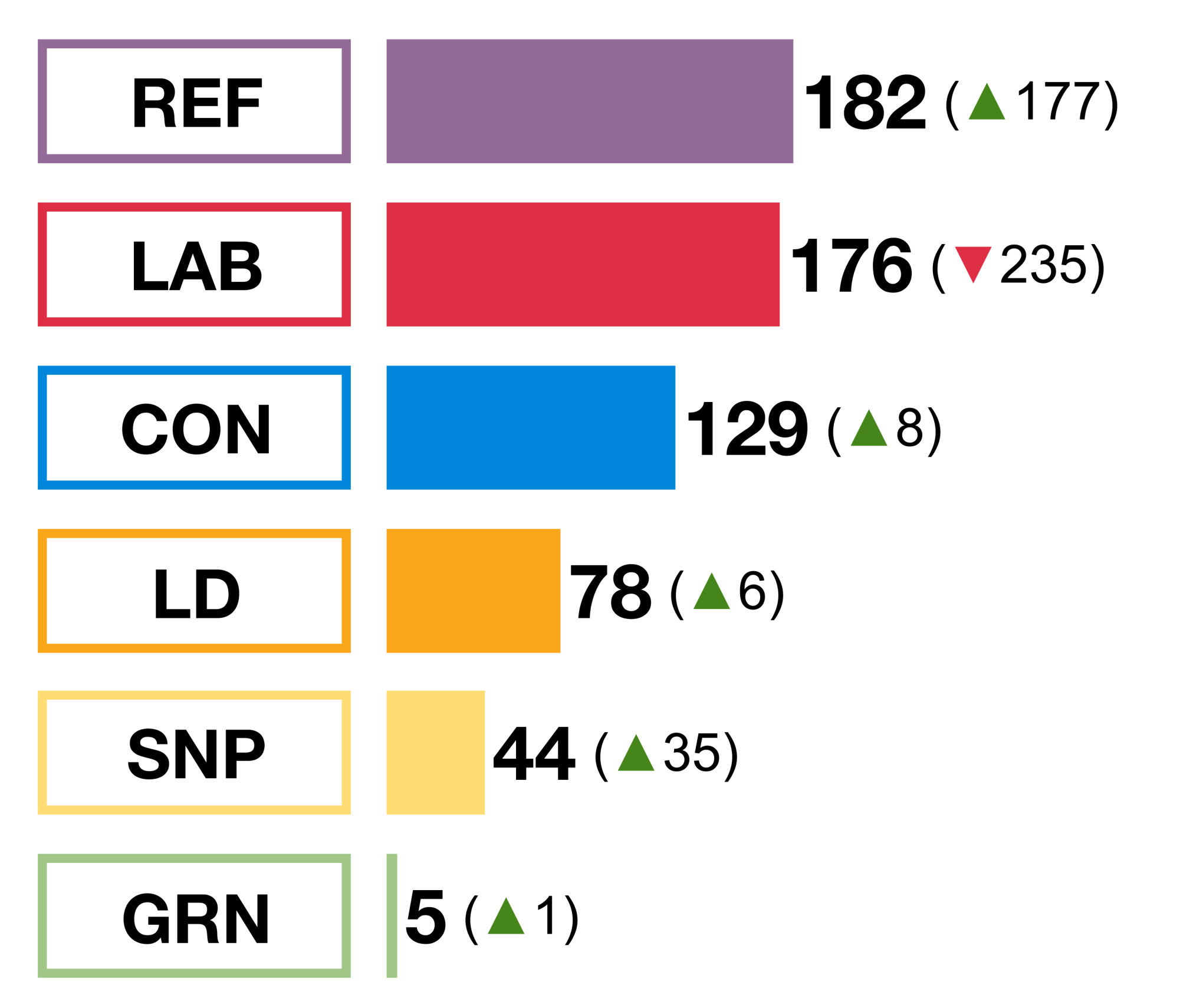
These figures are genuinely stunning. For the first time since 1910, the two major parties (Labour and Conservative) would not hold a combined majority, with third parties winning 345 seats (53%). Labour would suffer one of the greatest defeats of any British government, losing 235 of their 411 seats including 9 senior Cabinet ministers like Yvette Cooper (Home Office) and Wes Streeting (Health). The party would be wiped out in Scotland, would lose its dominance in Wales and the North, and would only win a majority of seats in London.
The biggest winner would be Reform, who would gain 177 seats to emerge with a narrow plurality – yet still a whopping 144 seats short of a majority. Most of their gains would be at the expense of Labour, who would end up with their lowest seat share since 1935.
The Conservatives, meanwhile, would be reduced to third place. Their 2024 result was their worst-ever, and this would barely be better (a mere 129 seats, or 8 net gains). The Liberal Democrats would gain 6 seats, bringing them to 78. Greens would be projected to gain one, but as they showed in 2024, their campaigns easily defy national models.
The other big winner, aside from Reform, would be the Scottish National Party (SNP). In the 2024 election they were virtually wiped out (going from 48 seats to 9) but polls now show them with a double-digit lead in Scotland, albeit one built on merely a third of the popular vote. But hey, that’s First-Past-The-Post (FPTP) for you – and having been destroyed by FPTP in 2024, the SNP would now benefit from it enormously, gaining 35 seats to win 44 out of 57 seats in Scotland. The briefly-dominant Labour would be crushed, falling to 2 seats (-37).
The political map of Britain would be totally reshaped. In 2024, Labour won at least a plurality of seats in every single region and nation of Britain (9 in total). Just eight months later, polls now suggest that the breakdown of results for regions/nations would be as follows:
This result would make it impossible for anyone to form a government. Reform, the Tories and right-wing unionists combined would total 318 seats (+185), while Labour and Lib Dems would enjoy 257 seats (-229) when allies in the North of Ireland (SDLP/APNI) are included.
The balance of power, such as it is, would be held by the nationalist parties (44 SNP, 4 Plaid) as well as Greens and left independents (5 Green, 13 independents). All told, anti-Conservative parties would have a narrow majority of just 5 seats. This would be utterly unworkable, a far cry from the solid landslide majority currently enjoyed by Labour.
Where Are Labour Votes Going?
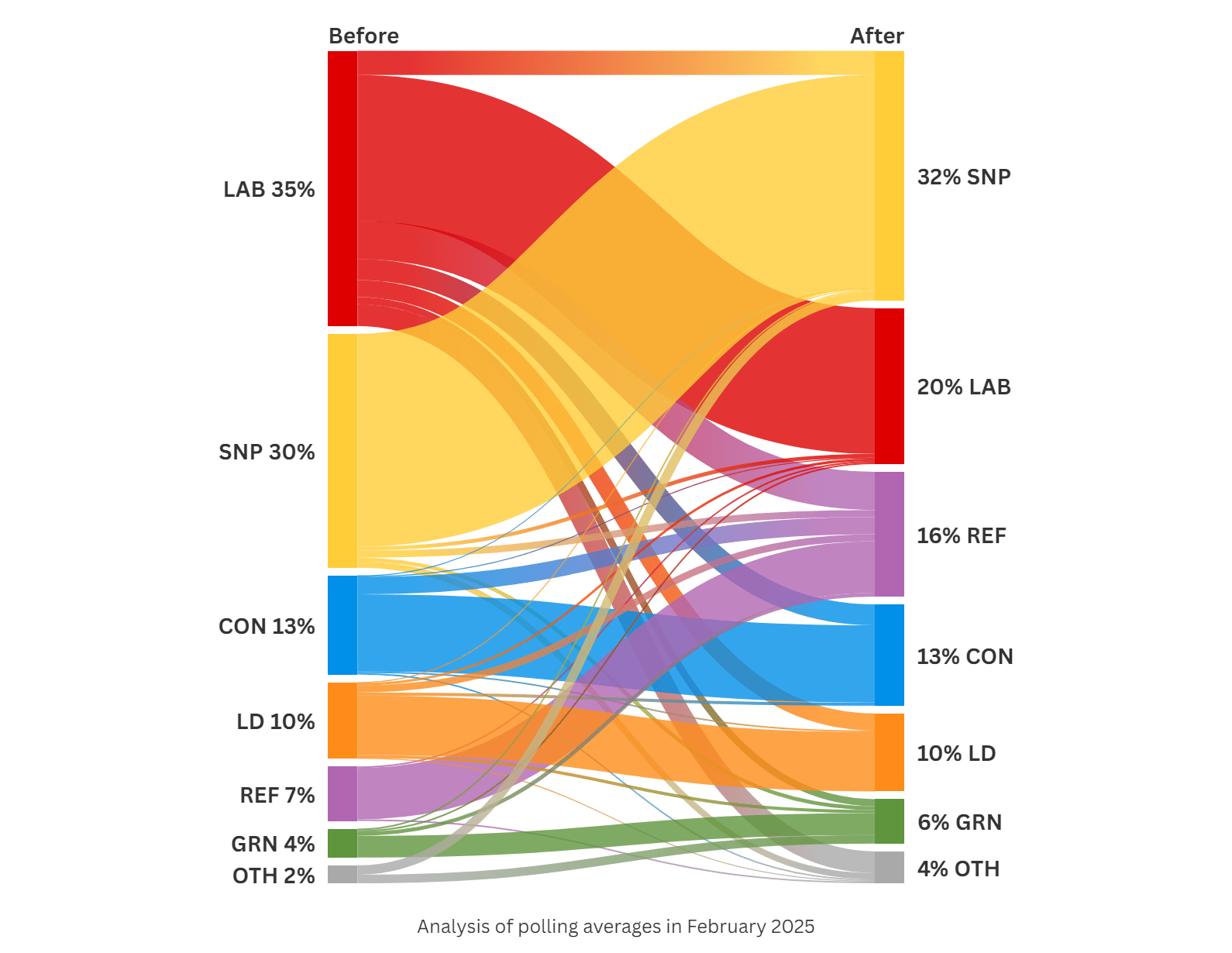
Since July 2024, around 3 million voters have turned their backs on Labour. But where have they gone? And how has support for other parties shifted?
On the surface, the headline figures suggest a simple 10pt swing from Labour to Reform. But it’s not that simple. Labour voters are going in all directions, with half (4.9pts) switching to the Lib Dems and Greens and only a third (3.3pts) flipping from Labour to Reform.
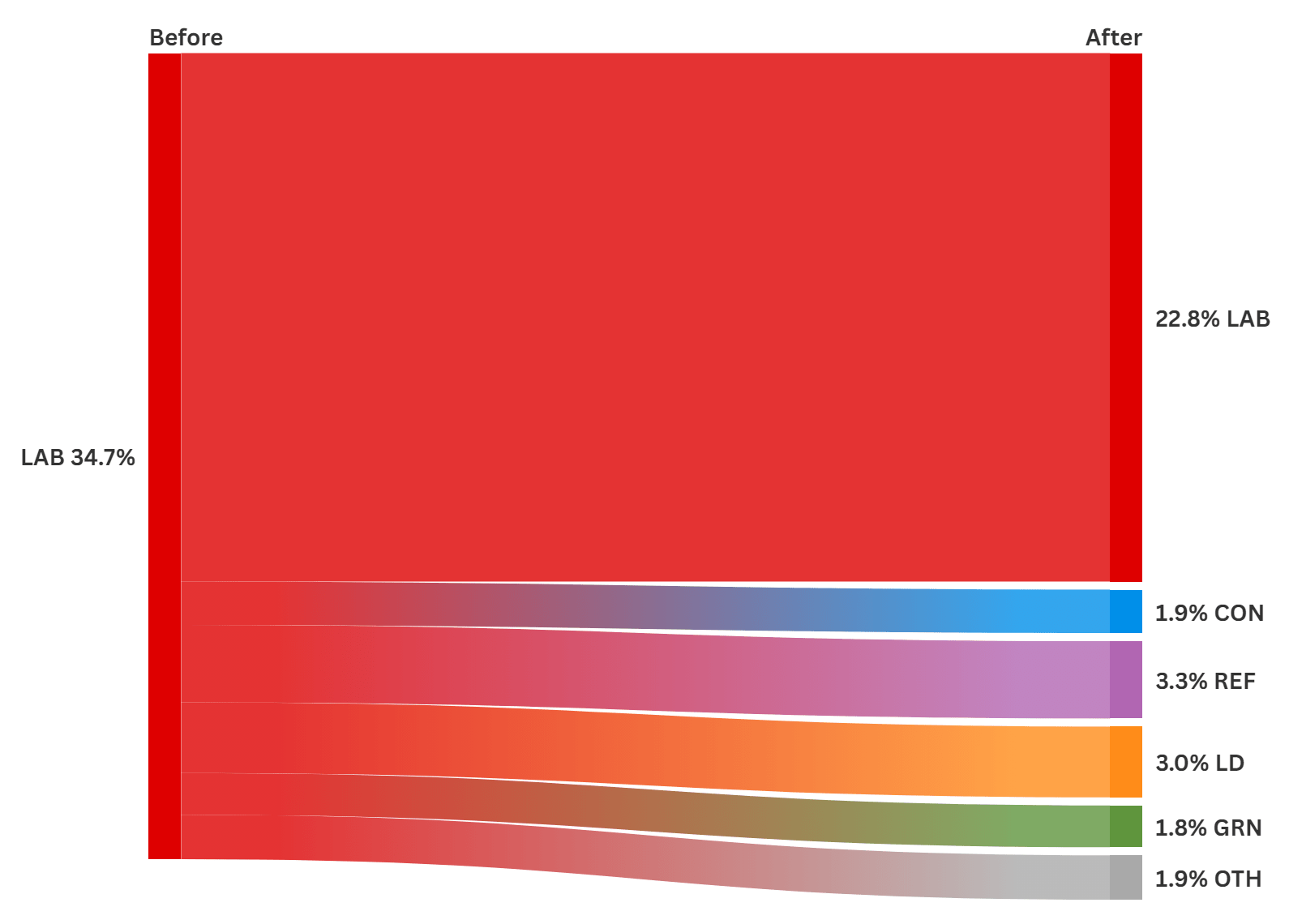
So what about the other parties? If Reform is up 11pts, but only 3pts is coming from Labour, where are the rest of these voters coming from? Well, nearly half (5pts) are coming from the Tories, not from the Labour Party. In essence, Reform is uniting the right-wing vote, but it is not doing so well at converting large numbers of voters from Labour to their side.
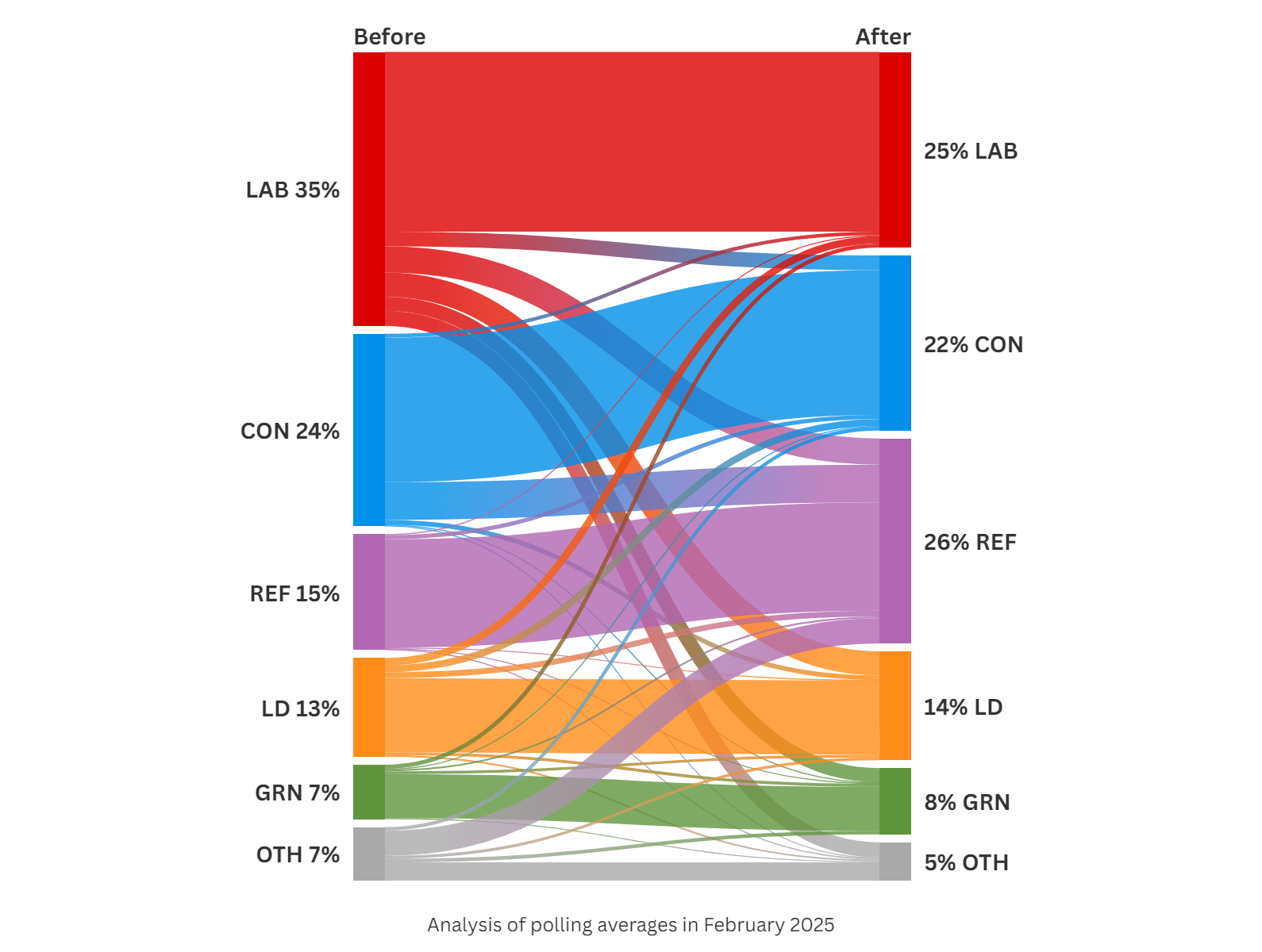
In Scotland, the shift in votes looks very different. The net result is that the SNP has established a huge lead which would give them over 40 seats; but beneath the surface, the SNP has gained very few votes directly from Labour. Scottish Labour is down 15pts compared to 2024, with only 3pts going to the SNP. Instead, Scottish Labour has lost votes to other unionist parties, but not to one in particular; their vote is scattering in all directions.
Everybody Hates Labour
All of this comes just 7 months after a thumping landslide win for Labour. So how has Labour’s polling collapsed? The answer is simple: voters despise Starmer and his government.
According to YouGov, Labour’s latest net approval is -41, with 19% approving and 60% disapproving. This is echoed by More in Common, who found virtually the same result (-50). The party’s approval rating started off as more-or-less neutral (-2), with lots of voters ready to give them a chance; but after Rachel Reeves abolished winter fuel allowance for most pensioners, Brits turned against the party in enormous numbers. Their approval has trended down ever since, only picking up slightly this week (likely due to the Ukraine crisis).
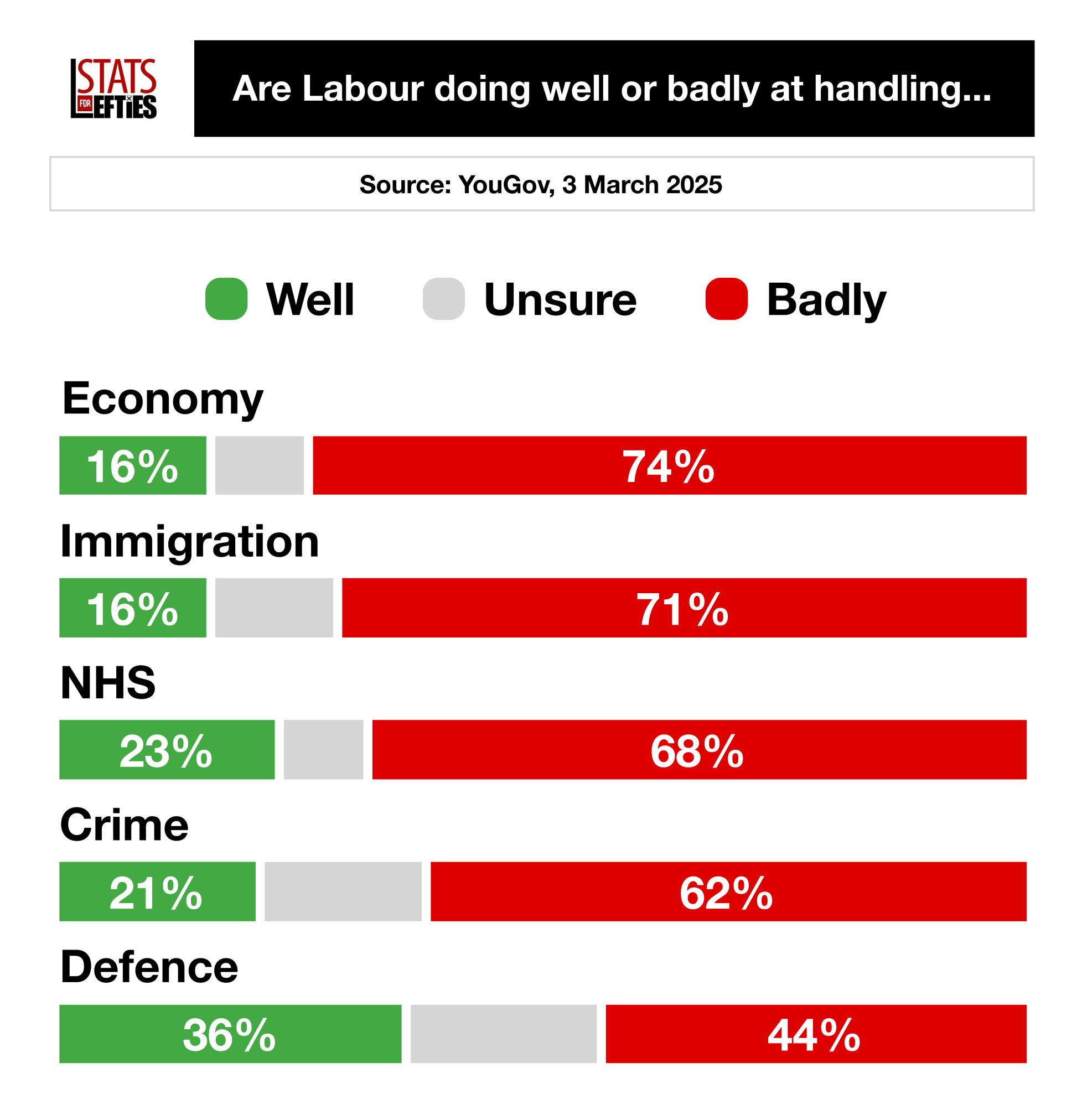
It’s not just general approval either: Brits think that Labour is handling the top issues poorly. Voters’ top five concerns at the moment are the economy (51%), immigration (46%), health (38%), defence (31%) and crime (20%). Labour has poor ratings on all of these, with the sole exception of defence – and that is likely due to the “rally around the flag effect“.
More specifically, voters have turned dramatically against Keir Starmer. When he was elected to the premiership, Starmer had a net approval rating of +9 (40% approve vs 31% disapprove). These were solid numbers for a Prime Minister whose majority was built on merely a third of the vote, and who was elected effectively by default. In the eight months since he won, this net rating has dropped at a shocking rate and is now -34, with a mere 23% approving and 57% disapproving. To put this in perspective, Corbyn’s net approval in December 2019 was -35.
Conclusion
This will all make very tough reading for Labour supporters. At just 25%, Labour is polling at its lowest level since 2009 (right before they lost office) and if this was repeated in an election it would be the party’s lowest vote total since 1918. As for seats, 176 seats would be the smallest group of Labour MPs since 1935 – almost a century ago.
This is very, very bad. But it could very easily get worse. The right-wing vote is currently divided between Reform (26%) and the Conservatives (22%), but united it easily outpolls Labour by double digits (48% to 25%). Reform has already begun uniting the right-wing vote behind them; gaining only a few more votes from the Tories (e.g. 2-3pts) would give Reform a commanding lead in seats. And with Reform growing in support every month, we should expect to see this happen at some point the next year. My guess would be right after the local elections, where Reform is expected to do well.
On top of this, Labour’s record on government is deeply hated by the electorate. This is not a party with a strong, dedicated base who will unite behind them in a competitive election. They started with a poor popular vote share (35% in Britain) and it has only gone down. Their leader is very unpopular, their rating on the economy is catastrophic, and the public are unimpressed by how Labour are handling public services. To return to my opening paragraph, voters backed Labour because they were promised that things would get better. They didn’t.
If things continue to worsen, Reform’s support will continue to grow. Labour does not seem to be bothered by this. Personally, I am very concerned about this prospect. If Donald Trump’s administration is any indication, a Reform government would be massively destructive for tens of millions of Brits. Labour, through their inaction and ineffectiveness, has opened the door to this potential outcome – but there is still plenty of time to avoid it. I hope we do.

