
Article made possible by my amazing patrons, including: Ben, Bert Rothkugel, Chris Gravell, Duncan Black, Emmett Donlan, Jane Turner, Joseph Bailey, Konrad, Mick McAteer, Neil Barton, Nicholas Martin, Patrick Lefevre, Ruth Holliday, Scott Folan, Thomas Alexander, Unicorn
In December 2019, all of the focus was on the defeat of Jeremy Corbyn. But the leader of the Brexit Party, Nigel Farage, suffered a far more humiliating defeat. While Corbyn lost seats, he still emerged with over 200 MPs; Farage, though, got nothing. His party received a mere 2% of votes, and was shut out of the Commons. In the months after, his party hit zero percent.
Yet five years on, the political situation could not be more different. Today, Farage is riding high following a crushing victory in the 2025 local elections; he is more popular than the Prime Minister and the leader of the opposition; his party is leading by a wide margin in polls; and seat projections indicate a decisive landslide majority for Reform, which would put Farage in Downing Street at the head of a Reform government – the first majority for a party outside the big two since 1906.
How did this happen? And how did this happen so quickly, with Labour going from a 172-seat majority to a humiliating local election defeat and a total collapse in the opinion polls? In this article I’ll try to explain where Reform’s support comes from, what has aided their rise, and where we stand as Britain enters a new era of party politics – however temporary it might be.
Voting intention
In October 2025, the average of polls was as follows (+/- vs the general election):
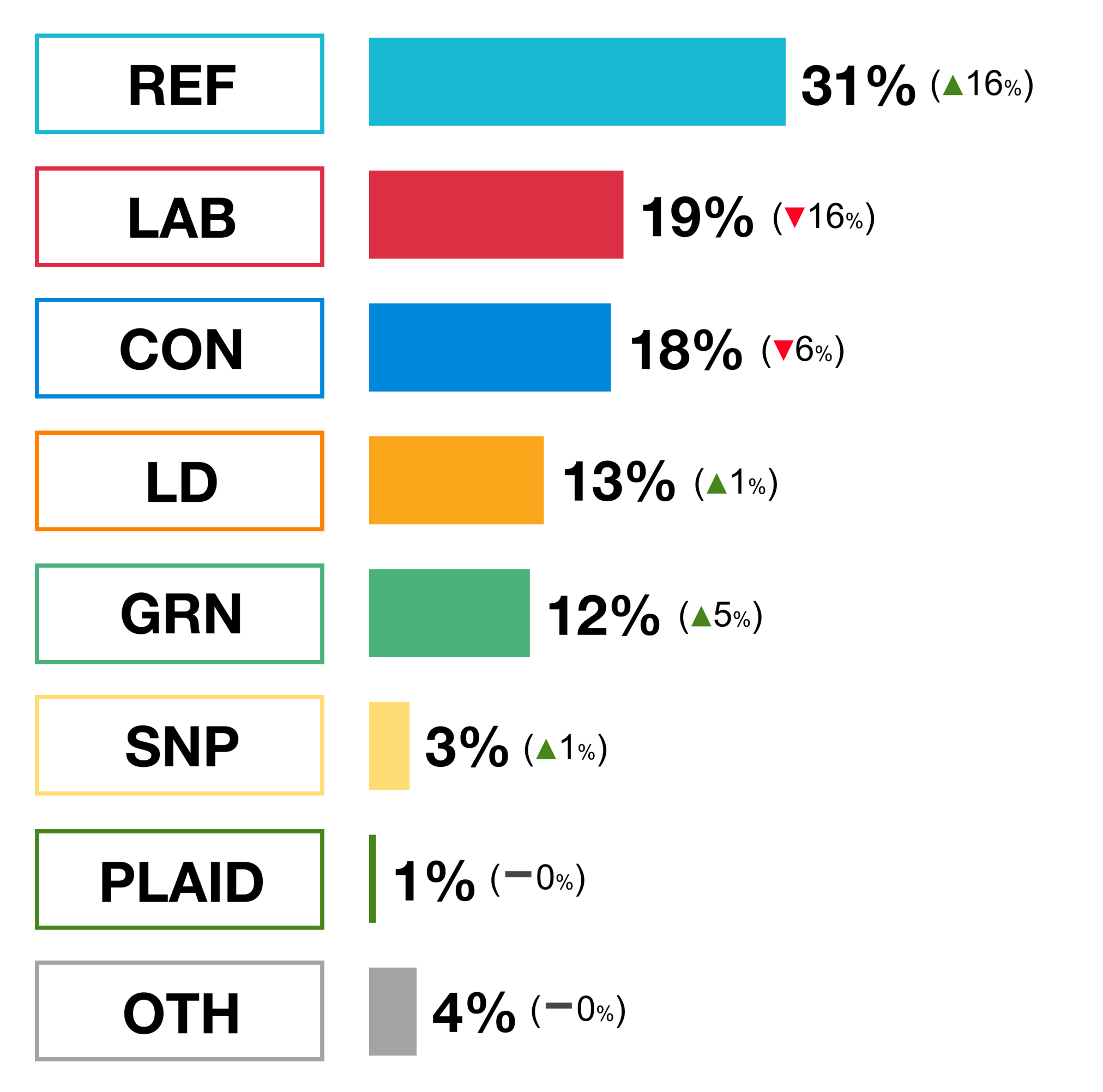
After 15 months in government, Labour has plunged to just 19% on average – the lowest that the party has ever averaged in the entire history of British political polling. This makes Keir Starmer’s government less popular than Gordon Brown at his lowest point, and dramatically less popular than Jeremy Corbyn in 2019. The main benefactor, though, has not been the opposition Tories – they are on 18%, which is less than in 2024. Instead, a party with just five seats in the Commons has surged to the top of the polls: Nigel Farage’s Reform UK.
In just over a year, Reform’s support in polls has more than doubled. Having trailed Labour by 20 points in July 2024, Reform now leads Labour by 12pts. This bigger than Labour’s margin of victory over the Conservatives in the 2024 election.
The other big winner is the Green Party, who have risen from 7% in the general election to a whopping 12% this month, putting them in double-digits for the second month in a row.
Seat projection
My NEW seat projection model (available here) suggests the following seat outcome:
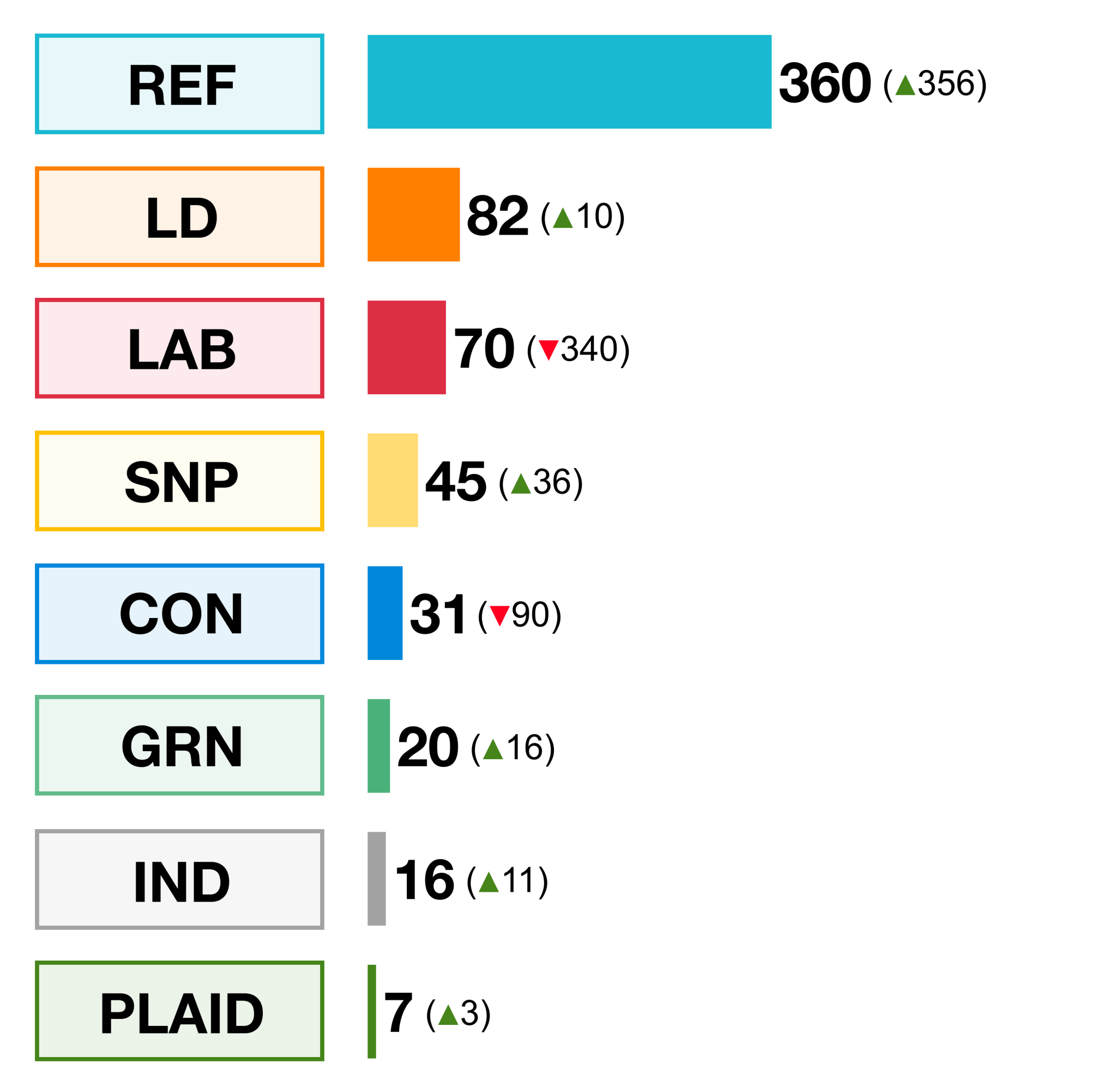
These figures are unprecedented. Both major political parties would be completely shattered, with Labour losing 339 seats, dropping to third place, with 15 of 20 Cabinet ministers losing their seats. The Conservatives would become a minor party, losing 90 of 121 seats.
On the flip side, the Lib Dems would emerge as one of the big two parties for the first time since 1918, seizing the mantle of centre-left opposition party from Labour as they have long dreamed. In Scotland, the SNP would bounce back from their 2024 defeat in a dramatic way, achieving a win as decisive as their 2019 landslide despite winning less than a third of the vote. Smaller parties would also be very happy, with Plaid achieving their best result (7 seats) and independents gaining 11 seats from Labour. Greens would win 20 seats (+16), their best-ever result – but perhaps a little disappointing given their 12% vote share. It should be noted that this is based on national swings, and local contests may be different. We are also overdue new regional polling in London, where the Greens will be targeting a lot of seats.
But the biggest winner, by far, would be Reform. Farage would lead his party to 360 seats, an overall majority of 70 – the first majority for someone other than the Tories or Labour since 1906. Reform would achieve landslide results in the Midlands (83% of seats), the North of England (74% of seats) and Wales (63% of seats), while winning decisively in the South outside London (59.5% of seats).
But in London and Scotland, their advance would be halted. Scotland would elect only one Reform MP, while London would only elect 13 Reform MPs out of 75 (17.3%).
Ultimately, underperforming in these areas would make no difference. Farage would become PM with a clear majority, able to enact his Trump-like agenda without opposition.
Labour would suffer the greatest defeat of any government in British history, losing 340 seats including fifteen senior Cabinet ministers like Shabana Mahmood (Home Office), Rachel Reeves (Chancellor), Ed Miliband (Energy) and Wes Streeting (Health). Keir Starmer himself would be in danger of losing his seat if “Your Party” and Greens fielded a joint candidate.
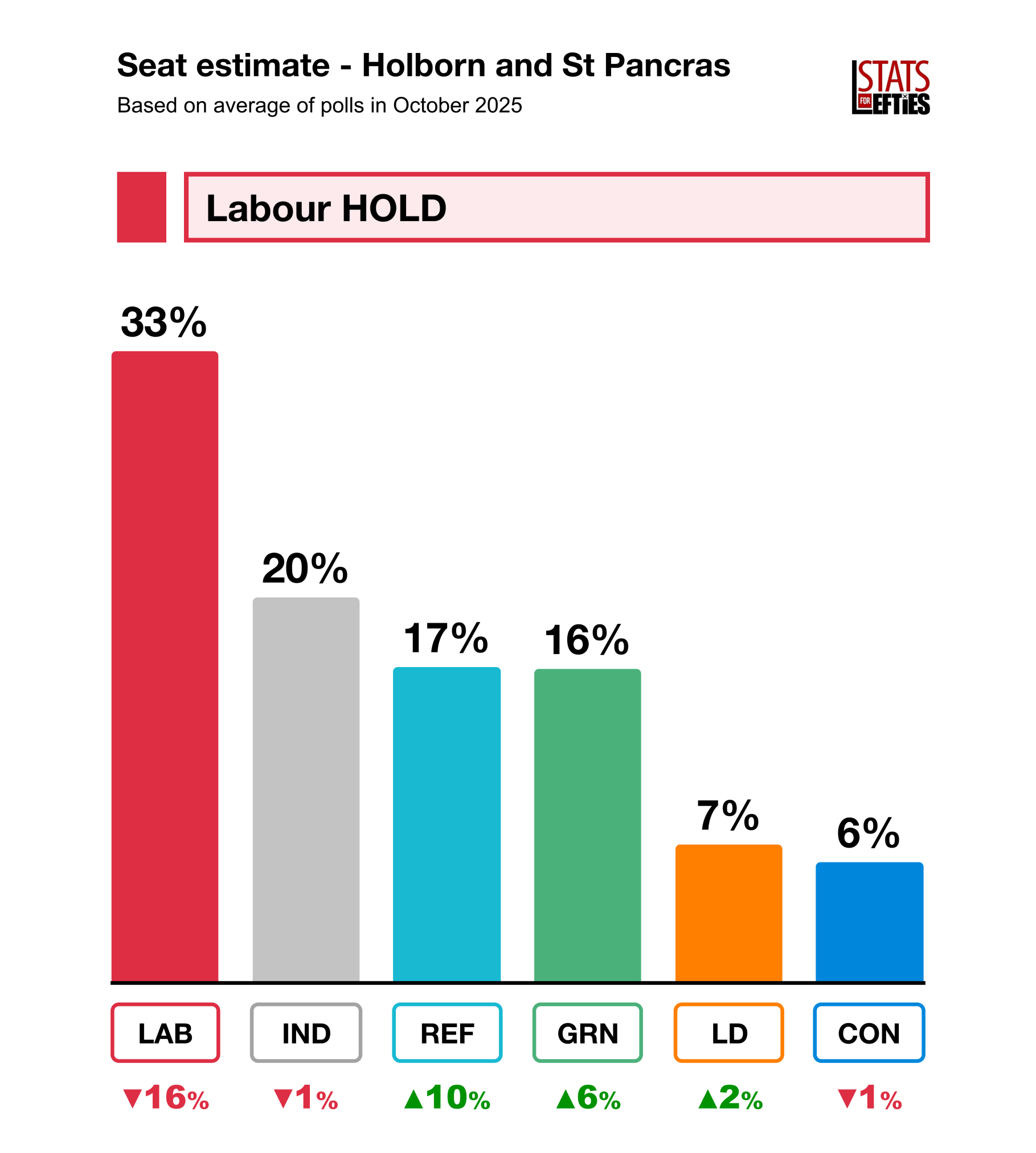
We need to take a second just to acknowledge the scale of this projected defeat. If repeated in an election, it would be the worst in history, with Labour losing 83% of the seats they won in 2024. Even the Whigs in 1685 (-82% of seats) and Labour in 1931 (-82% of seats) experienced less severe defeats than this. Labour would win just 70 seats, its worst result since 1931.
It would be a generational crushing, the sort of result that might actually destroy the party entirely. And all of that is before Your Party enters the fray.
How has this happened?
The popular wisdom, as articulated by the Labour Right and the newspapers, is that this dramatic transformation has occurred solely because working-class Labour voters have switched to Reform over the issue of immigration. According to this thesis, winning in 2029 therefore requires a massive nationalist crackdown on immigrants of all kinds. But not only is this deeply immoral and fascist – it is also based on a totally incorrect mathematical theory.
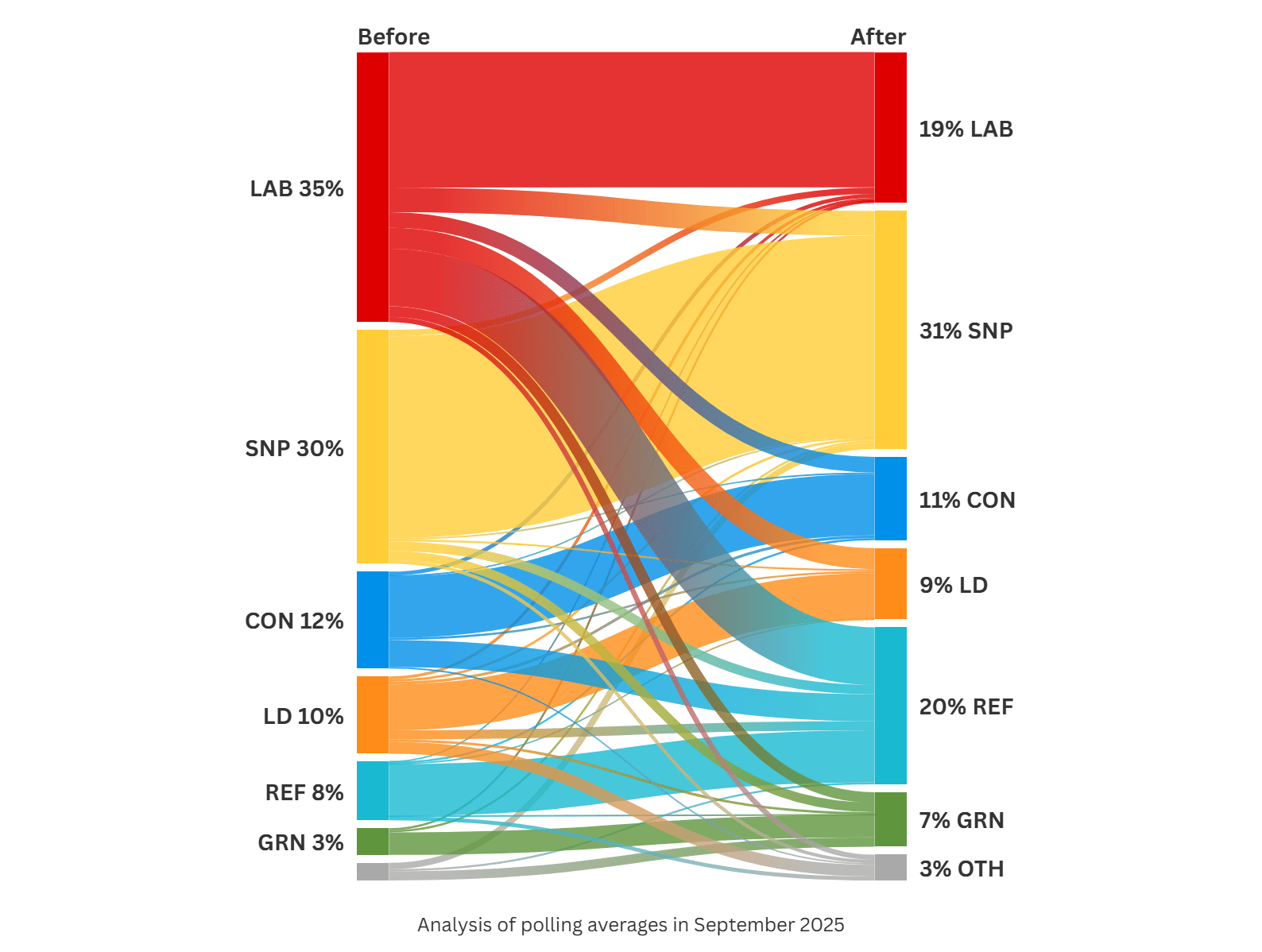
Since 2024, Labour has lost almost 50% of its own voters – representing 17 percentage points in total. These defecting voters have split as follows:
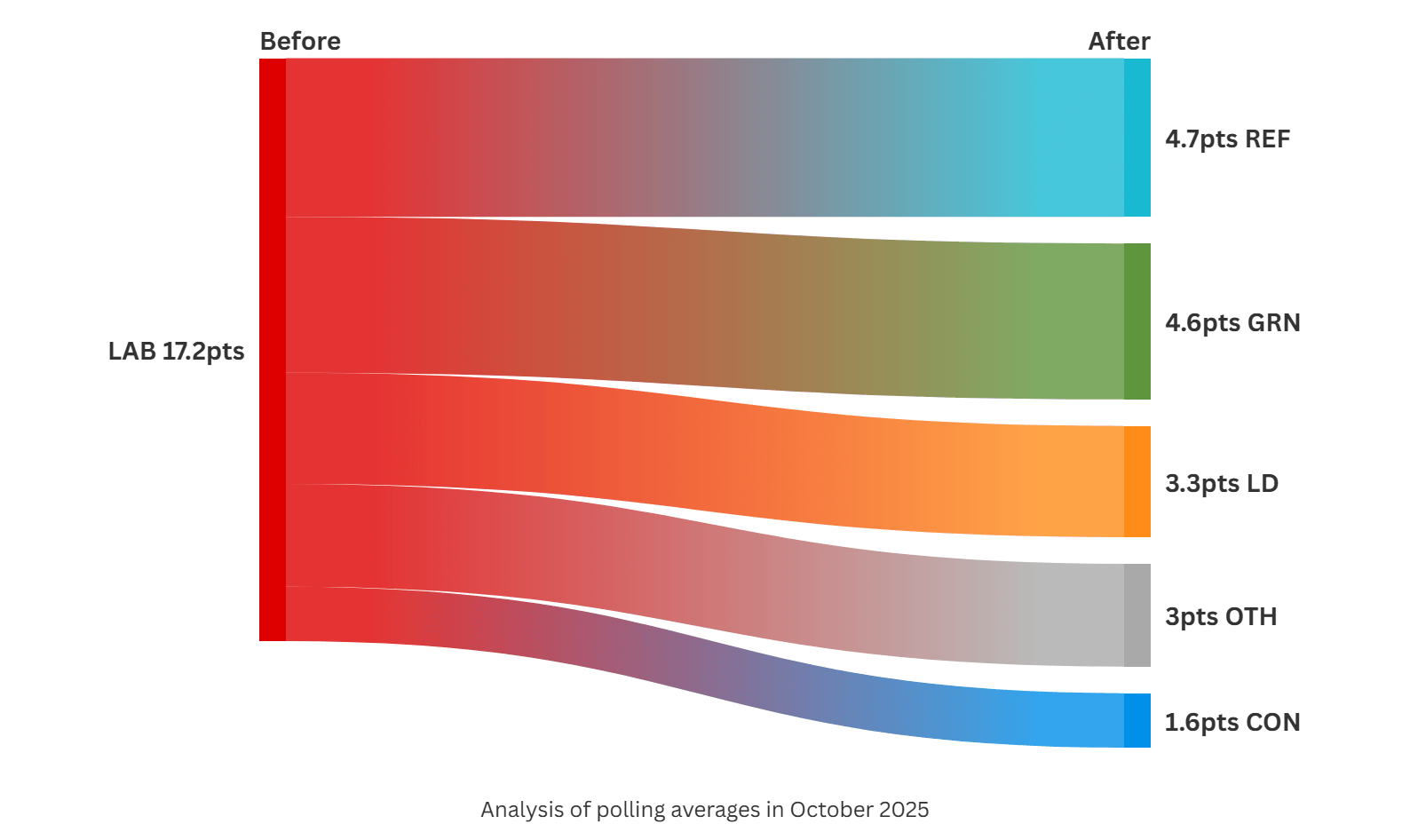
In other words, two-thirds of defecting voters (10.8pts) have turned left and just over a quarter (4.7pts) have gone to Reform. Labour is losing just as many votes to the Greens (4.6pts) as they are to Reform! Labour’s biggest problem is on its left flank, not on its right. If it regained all the votes lost to Reform, it would STILL be trailing Farage in polls.
In Scotland, the shift in votes looks very different. The net result is that the SNP has established a huge lead which would give them 46 seats (up from 9); but beneath the surface, the SNP has gained very few votes directly from Labour. Scottish Labour is down 16pts compared to 2024, with only 3pts going to the SNP. Instead, Scottish Labour has lost a third of its 2024 vote to other unionist parties, with the biggest chunk (7pts) going to Reform.
As a result, the narrative being spread by Morgan McSweeney and his lackeys is based on blatantly false assumptions. The loss of support for Labour is about much more than just migration or culture war nonsense; it is about a total shattering of trust in a government that was elected on a simple program of “change” and failed to deliver it in any meaningful way. How do I know this? Simple: when asked if they think Labour represents a change from the Tories, 7 in 10 Brits say NO.
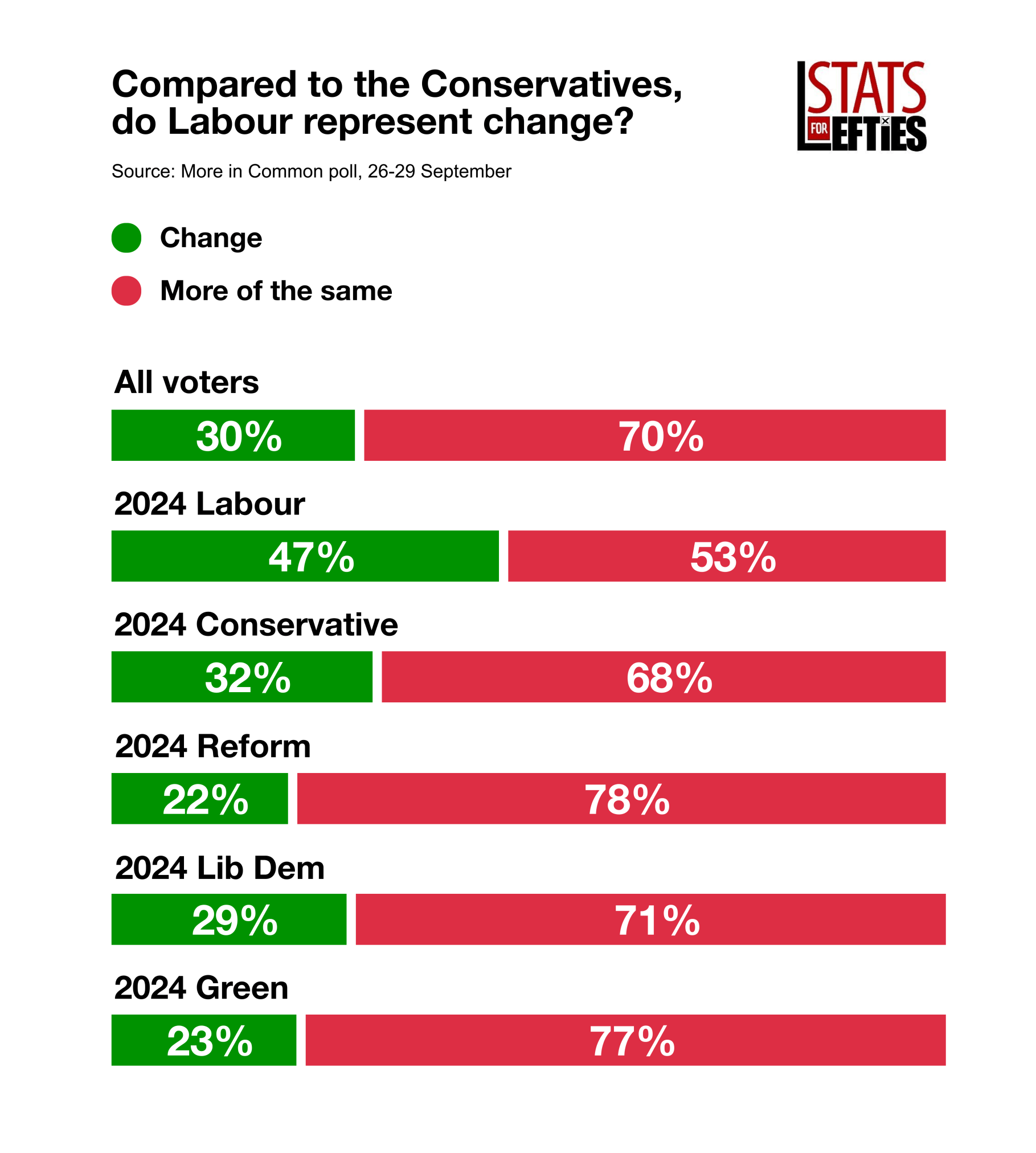
This is a damning verdict for the party, but the ratings for the leadership are even worse.
Leadership approval ratings
In October, Starmer’s net approval rating was a stunningly low -44. Just 20% of Brits approve of his performance, putting him below Your Party leader Jeremy Corbyn (21%).
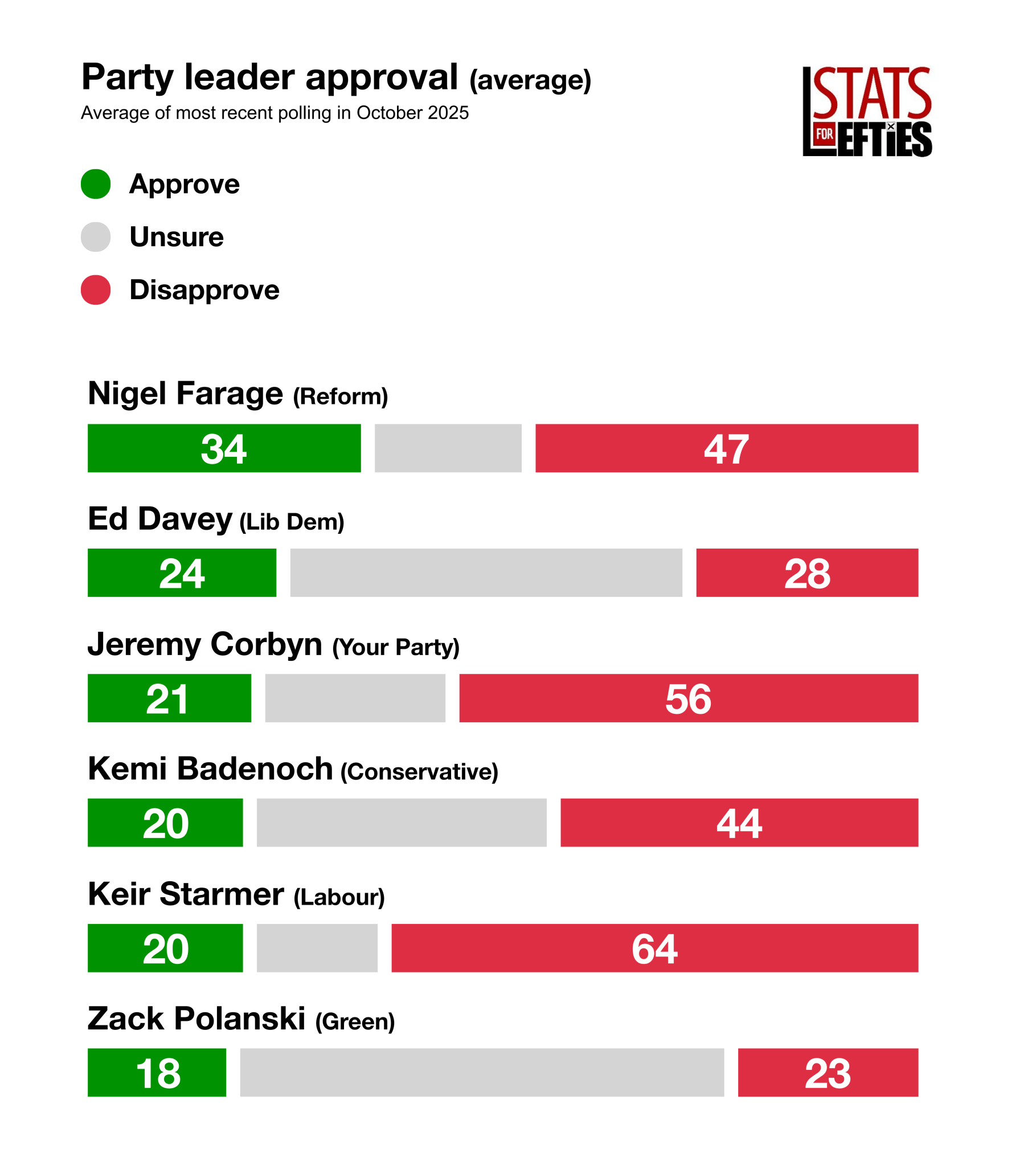
Starmer began his time in office with relatively strong ratings (+9), but they have fallen quickly. Despite hopes of a revival following his widely-publicised anti-Russia speech in March 2025, an unpopular budget and local election wipeout have obliterated any resurgence.
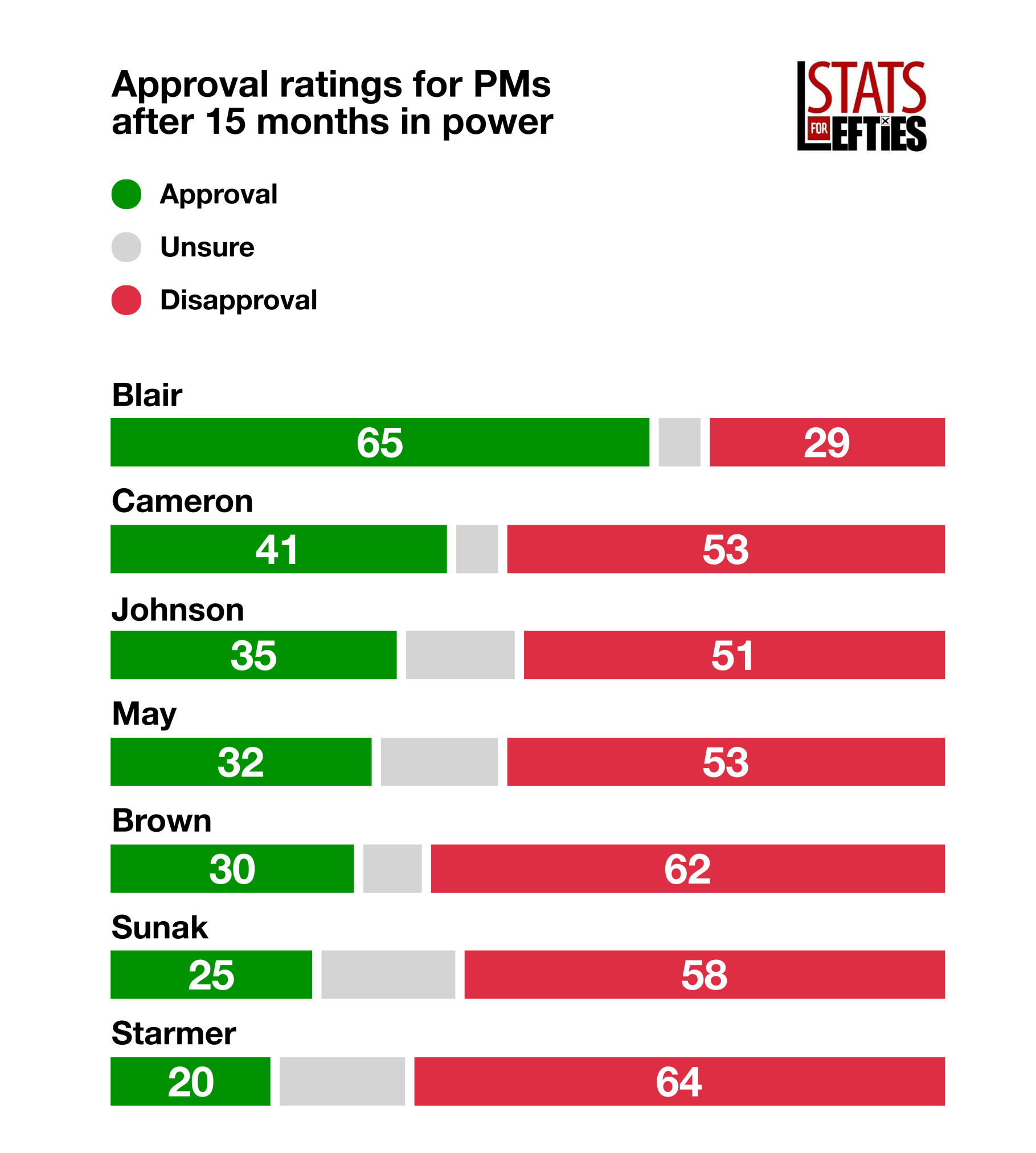
After his first year in office, he now sits at a lower rating than any PM on record.
The government’s image
As for the government itself, their overall ratings are abysmal. Just 1 in 10 approve of their performance, ratings on par with the Tories’ after they had spent almost 15 years in power.
The cause of this decline is immediately obvious: policy. The party’s approval rating initially plunged after their decision to slash winter fuel payments (WFP) and never recovered. Each subsequent budget and policy announcement has seen them decline further. Every time the public gets offered a real policy by Labour – rather than the vague promise of “change” – the party’s support falls further.
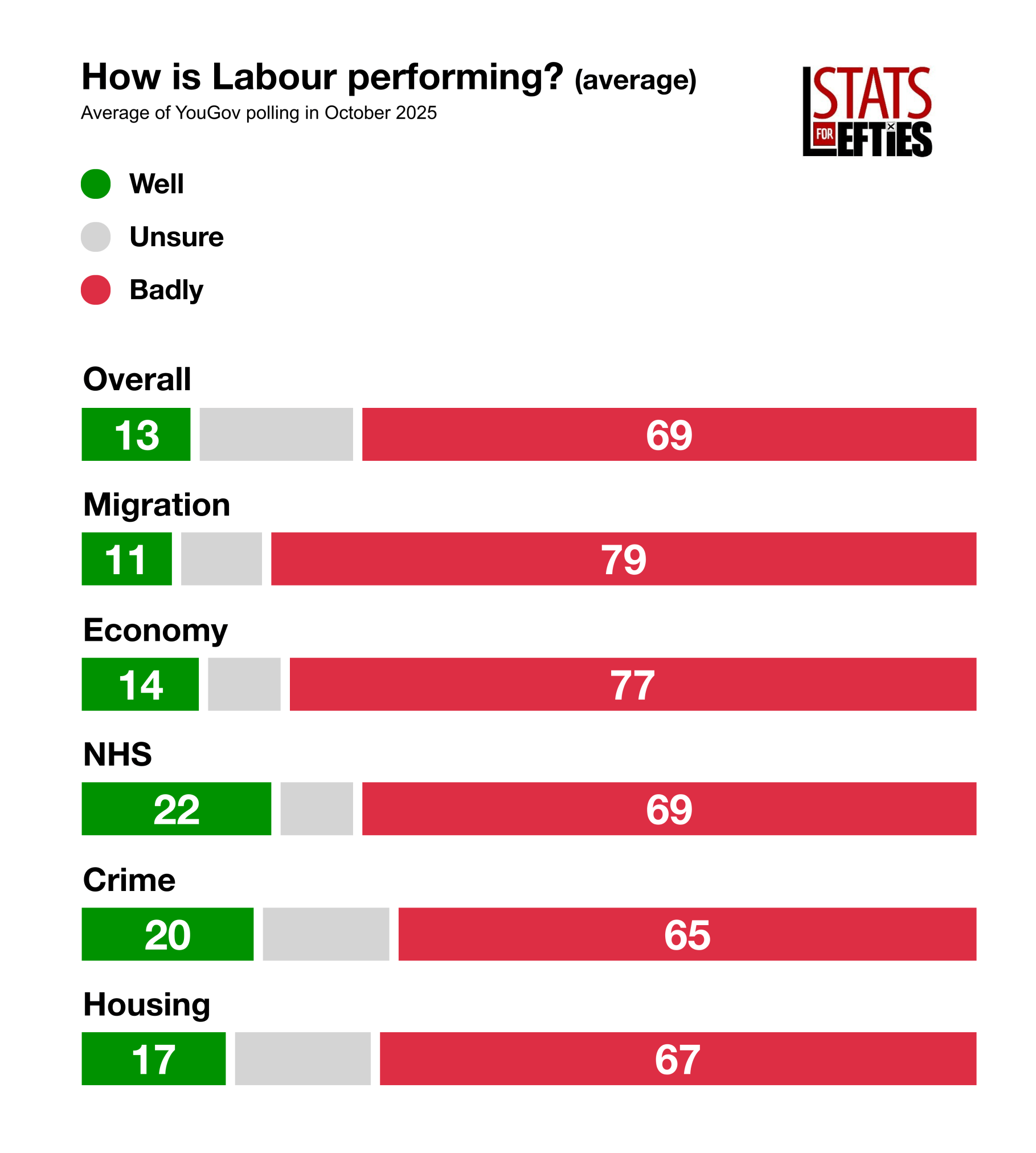
On every policy area of importance to the public, Labour is seen as a catastrophic failure. Voters’ top five concerns at the moment are immigration (56%), the economy (53%), health (32%), crime (22%) and housing (18%). Labour has utterly abysmal ratings on all of these issues. Worse still, its ratings on migration (-68) and the economy (-63) are worse than their overall rating – meaning that Labour’s performance on the public’s top two priorities is dragging them down.
Another cause of the shattered public trust in Labour have been the numerous scandals and controversies, from the stories of Labour ministers raking in free goodies to the outrage surrounding Peter Mandelson’s links to Jeffrey Epstein. Since the party took office in 2024, the proportion of voters who feel that Labour is “in touch” has plunged from 31% to 12%.
Conclusion
In my last review of polls in March, I wrote:
“This is very, very bad. But it could very easily get worse. The right-wing vote is currently divided … but united it easily outpolls Labour by double digits … Reform has already begun uniting the right-wing vote behind them; gaining only a few more votes from the Tories (e.g. 2-3pts) would give Reform a commanding lead in seats. And with Reform growing in support every month, we should expect to see this happen at some point the next year. My guess would be right after the local elections, where Reform is expected to do well.”
Events transpired exactly as I predicted. After their victory in the locals, Reform took a boatload of votes from the Conservatives and became the dominant party of the British right. As a result, they have established a commanding double-digit lead in polls, consigning the Tories to irrelevance. From a high of 207 projected seats in November 2024, the Tories under Kemi Badenoch are now projected to win only 31 – a third of them (11) in London.
The one saving grace for Labour is that the Reform surge appears to have stabilised. For the past six months Reform have averaged around 30 per cent of the vote in every month, which is an extremely low vote share to be relying on. Their ability to tap the Tory well also seems to have plateaued; the Tories began averaging around 18 per cent after the local elections, but have not fallen any further. With the right-wing vote fixed in place, and a big pool of left-leaning voters to squeeze in an election campaign, Labour might think they can rest easy.
They would be wrong. The left-leaning voters that Labour has so loudly told to get lost now have other options. The formation of Corbyn’s 50,000-strong new party (averaging 6% when included in polls) threatens to draw both votes and seats from Labour in cities and left-wing areas, while the rise of Zack Polanski has began to transform the Green Party (averaging 12% in standard polls) into a 150,000-strong party of the populist left. With one pollster, the Greens have already pulled ahead of Labour. In Scotland, the Labour vote has collapsed and the SNP have taken their place; in Wales, Plaid Cymru look set to surpass Labour in the 2026 Senedd elections and lead the Welsh government for the first time. In local constituencies, meanwhile, independents and localist parties are besting Labour, the Tories and Reform. Viable electable alternatives are everywhere. “Only Labour can beat the Tories” just isn’t true.
Labour will do its best to win “tactical” votes from people desperate not to let Reform into power. But this will not work. Reform went from just 1% in polls in 2022 to leading the government by double digits in 2025. In just three years they went from total irrelevance to potential government. In this context, the old arguments about “tactical voting” and “only Labour can win here” no longer sway the electorate. Labour will find that it can no longer simply bank the leftist vote and make an aggressive play for the votes of racists and landlords. Voters dissatisfied with Labour’s genocidal, transphobic, austerity-backing regime now have many alternatives to choose from – and with every month that passes, more and more of them decide that they’ve had enough. Perhaps Your Party or the Greens cannot do what Farage has done in terms of gaining support; but it seems that voters are so fed up with Labour that they’re willing to give it a damn good try.
 Stats for Lefties
Bloody good article. ‘Labour’ are a bunch of careerists with no substance. Yet the Reform-lite love-in continues.
Let them continue to underestimate the people. There is far, far further to go for YP and The Green Party before 2029.
LikeLike